It’s midnight and it’s your turn to close up the terrace. You stack the last chair, wipe down the bar, and when you finally lean against it, you notice your calves are stiff, as if you’d been climbing stairs all afternoon. The funny thing is that you’ve barely moved three square meters: from the coffee machine to the beer tap, and back again.
Your legs get tired from working on your feet because, when you’re still, your calf stops pumping and the blood stays down below, in your ankles and calves.
Let’s see what happens down there during your shift, which part is the leg and which is the foot, and what you can do both at work and when you get home. Without changing jobs, since you’ve probably already thought about that on more than one night.
Why do your legs get tired and ache from working on your feet?
Try this next time you come back from the supermarket: grab a full bag, stretch out your arm, and stand still. Don’t lift it or lower it, do nothing, and yet after a few minutes, your shoulder starts to burn. If you walk while swinging your arm instead, you can hold it for much longer with the same weight.
Something very similar happens to your legs behind a bar, a stretcher, or a counter. To keep you standing, your calf and thigh muscles are working the whole time, but without moving: they are contracted to hold your posture. This static effort reduces blood flow and brings on fatigue sooner, while at the same time, blood accumulates in your legs and feet2.
That blood has to travel back to the heart uphill, and for that, the leg has help: the calf. Each time your calf contracts while taking a step, it squeezes the veins running through it and pushes the blood upward, and tiny valves inside the vein prevent it from falling back down. When walking, that push is repeated with every step. When standing still, the calf stays under tension but without that squeezing and releasing, and the blood is left waiting at the bottom.
If you want the full picture of the causes, beyond work, you can find it in our post on why legs swell.
Why is standing still more tiring than walking?
For the same reason as the shopping bag. When walking, the muscle contracts, relaxes, receives fresh blood, and contracts again. Standing still leaves it in a sustained contraction that never gets a rest, and it also takes away the leg's return pump.
That’s why there are shifts where you haven’t even taken two thousand steps and you arrive home more exhausted than after a long Sunday walk. The walk tires out your muscles, yes, but it keeps the blood moving; the day spent standing still tires you out and, on top of that, leaves the blood at the bottom.
The same thing happens between the waiter who moves back and forth between tables and the bartender who spends hours in the same square meter. Both are on their feet, but the latter's legs receive many fewer pumps from the calf throughout the shift.
Why do your legs swell at the end of the day?
When blood spends more time down below, the pressure inside the veins of the leg increases, and some of the fluid leaks out into the surrounding tissues. You notice it first in the ankle because it’s the lowest point, and the skin there is thin and there’s no muscle to hide it.
That’s why the shoes that fit easily in the morning feel tight at eight in the evening, and why taking off your socks reveals that indented line above your ankle.
This end-of-shift swelling usually follows a fairly predictable pattern: it increases as the day progresses and goes down by the morning. Further below, we’ll tell you what to do when it doesn't follow that pattern.

Do your legs ache or your feet?
It’s worth distinguishing between the two, because what relieves one thing might not relieve the other.
- If your leg is what hurts. Heaviness in the calves, tightness, the feeling of "loaded" calves, swollen ankles that leave a sock mark... That has to do with circulation and muscles that have spent hours supporting you, and is the domain of movement, legs-up, and compression.
- If your foot is what hurts. Burning soles, stabbing heel pain with your first steps, sore feet at the end of the day... Here, it’s mostly about your footwear, the floor you work on, and how you walk. A compression sock can do little there, because it doesn’t compress the foot area: it’s deliberately loose.
They can go together, of course, because a long day on a hard floor punishes both. But knowing which bothers you more helps you choose where to start. If it's your heel, we have an entire post on how to relieve heel pain from plantar fasciitis.
What are the consequences of standing for many hours?
Two researchers from the U.S. National Institute for Occupational Safety and Health (NIOSH) reviewed literature on working on your feet and found a connection to several health problems. Regarding the legs and feet: leg pain and fatigue, sore feet, swelling, and a higher risk of venous issues such as varicose veins2.
That doesn’t mean working on your feet condemns you to anything. It means that the leg accumulates strain shift after shift, and it’s worth giving it a hand before the discomfort becomes an everyday occurrence.
Is it true that standing for a long time causes varicose veins?
It’s the question Google suggests as soon as you search for "working on your feet," so let’s answer it with data.
The benchmark study followed 5,647 Danish workers for twelve years. Those who spent at least three-quarters of their shift standing or walking had a 78% higher risk of ending up treated in a hospital for varicose veins than the rest, and the authors calculated that standing at work explained more than a fifth of those cases during working age1.
Read carefully, the data says two things. That standing for many hours is a measured risk factor, and that it has an impact. And that it’s not the only one: family history, age, and pregnancies—which are not dependent on your shift—also play a role in the development of varicose veins.
What is within your control are your habits: moving during the workday, not spending hours stuck in one spot, elevating your legs when you get home, managing your weight... We discuss this in more detail in these routines to prevent varicose veins.
What to do during your shift so your legs don't ache?
The underlying idea is to give the calf back the work it loses by being still. The occupational health guidelines collected in the NIOSH review are along these lines: change posture often, take breaks, and don’t chain together too many hours on your feet without any help. The guidelines for operating room nurses in the U.S., for example, recommend not spending more than two hours standing without some measure to reduce fatigue2.
In practice, at your workplace:
- Go on your tiptoes and come back down. Ten or fifteen times, while the coffee is brewing, while the receipt is printing, or while the customer is deciding. It’s the same movement the calf makes when walking, without moving from your spot.
- Shift your weight from one leg to the other. Rest one foot on the bottom bar of the counter, on a step, or on a box, and alternate. The leg that is resting stops supporting all the weight for a while.
- Take advantage of every move. Go get the material yourself instead of asking for it, carry the dishes in two trips instead of one... Each short walk is a handful of free calf pumps.
- Keep your knees loose. With your knees slightly bent instead of locked backward, it’s easier to move your weight from one foot to the other without realizing it.
- Footwear that supports you. Comfortable, your size, no high heels, and good arch support. The NIOSH review includes appropriate footwear and insoles among the measures that help in standing jobs2.
- Sit during breaks, with your feet up if you can. Ten minutes with your legs on another chair gives your blood a break from the uphill climb.
And so on with whatever occurs to you according to your job. You don't have to do them all: as long as your calf doesn't spend three hours without moving, you’ve already gained a lot.

How to relieve tired legs after working?
When you get home, your body wants you to collapse on the couch just as you are. It’s worth reconsidering the order.
First, walk for a while. Ten minutes of walking, going down to get bread, or circling the block gets your calf pumping and helps move the blood that has been down below for hours. After that, yes, legs up: lying down, with your feet higher than your heart, on a couple of pillows or propped against the wall, for a good while.
And watch what you do right after. If you arrive and spend half an hour standing in front of the stove, for your leg, it’s like continuing the shift. Better to do something you can do sitting down, or switch postures while you cook.
If there’s someone at home with the opposite problem—the entire day in a chair—we discuss their situation in the post on legs swollen from sitting: the mechanism is a close cousin to this one, although the advice changes.

Do compression socks help if you work on your feet?
If the problem is that your calf doesn't push enough while you’re still, it makes sense to give it a hand from the outside. That’s what gradual compression does: it’s tighter at the ankle and loosens toward the knee, so the blood has an easier time on the way up.
The study that most resembles a real workday was done with 108 hairdressers, who wore light compression stockings (15 to 20 mmHg) for some weeks and not others. With them, the lower part of the leg had on average about 19 ml less volume, and the pain and swelling score dropped by 12%3. Nineteen milliliters is a little more than a tablespoon, and yet you can notice it in how tight the shoe feels at the end of the day.
Now for the honest part. A Cochrane review, which is one of the most demanding standards for evaluating studies, looked for trials on how to prevent venous problems in standing workers and found only one that met their criteria, involving 19 flight attendants. It suggested that the stockings improved leg fatigue, but with so little data, the authors concluded that no firm statement on prevention can be made4. The NIOSH review, meanwhile, sees less perceived fatigue, pain, and swelling in most studies, but less clear results when physical changes are measured2.
Translated: light compression helps make the day more bearable. What it doesn’t have is evidence to promise it will avoid a varicose vein, and we are not going to promise you that.
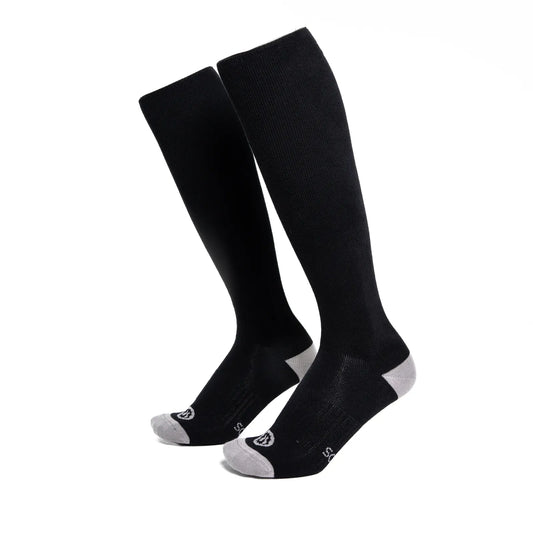
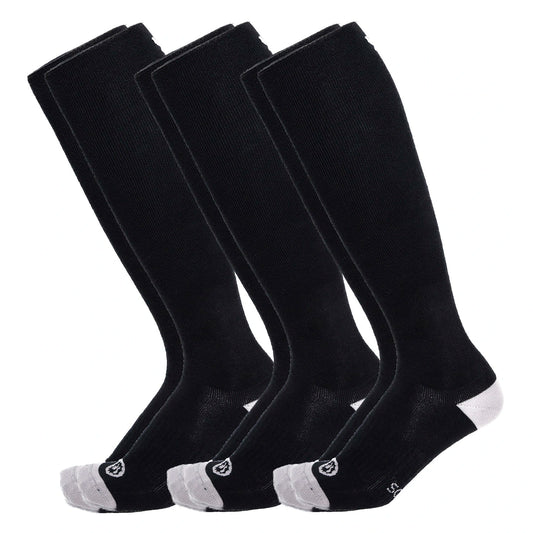
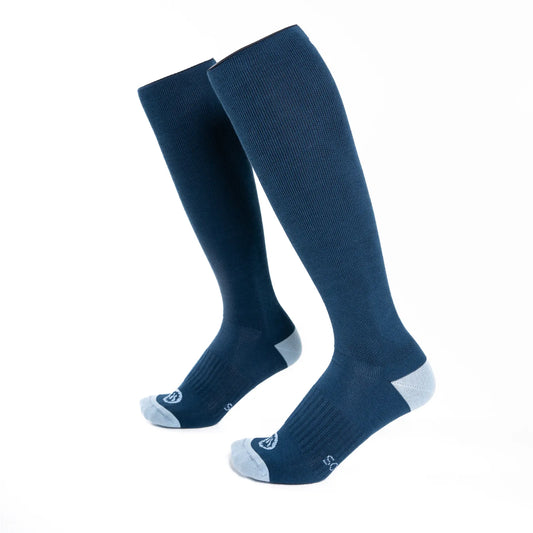
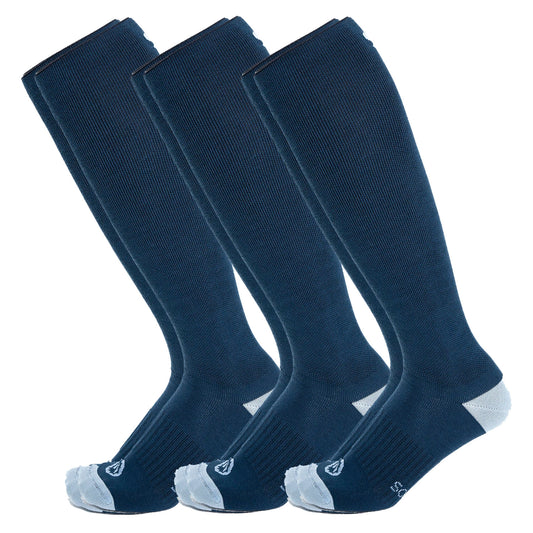
Our Calcetinos have light gradual compression of 14 to 17 mmHg, tested in an external laboratory, OEKO-TEX Standard 100 certification, and are made in Spain. If you want to know what those numbers on the label mean, we explain it in what mmHg means in compression stockings.
To be clear: these are not a medical product and are not covered by prescription. If a doctor has prescribed strong compression, that goes through the pharmacy; if yours is the light kind for everyday use, we explain it in where to buy compression stockings, pharmacy or online.
And they have a few details worth knowing before you wear them for the first time:
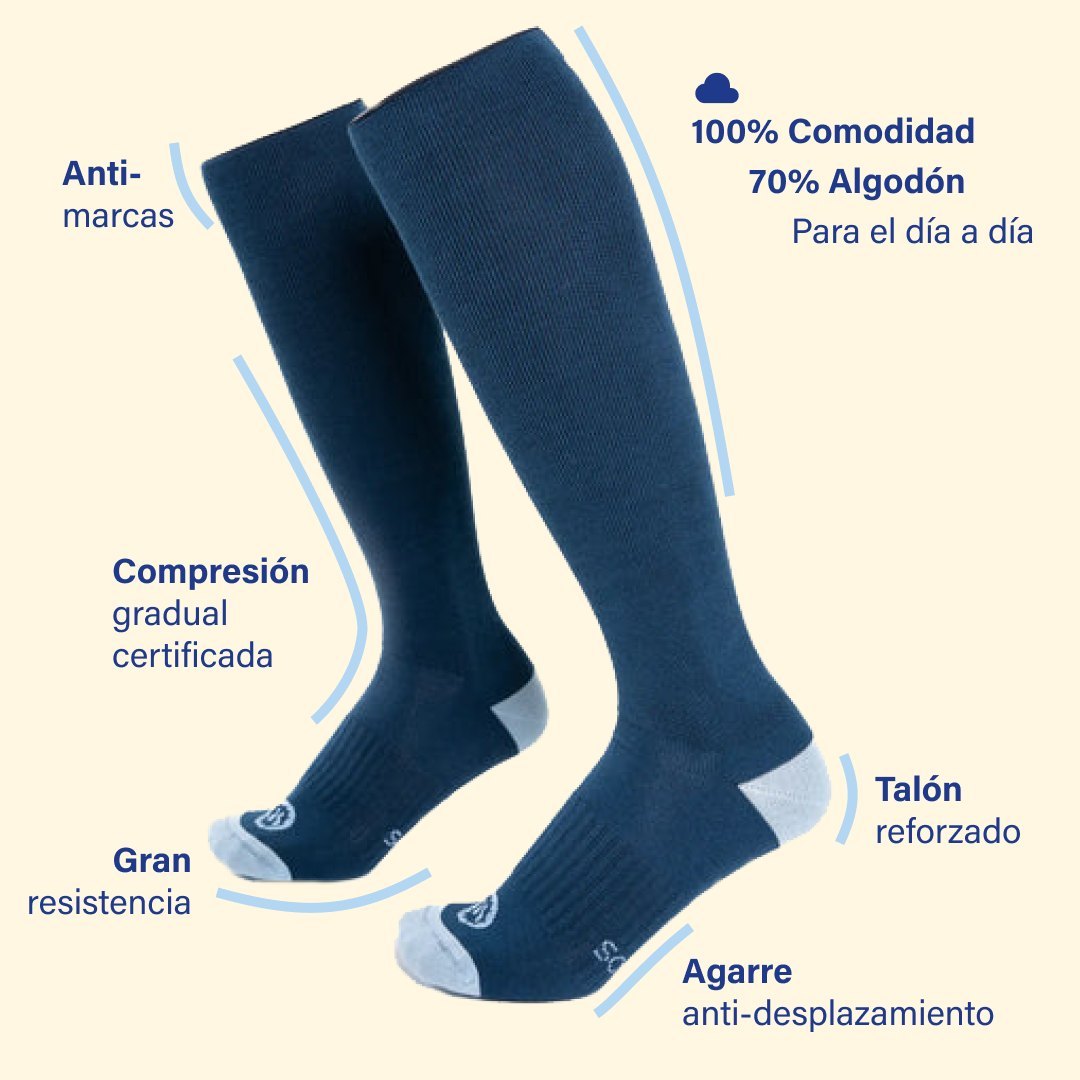
- The top part is intentionally loose. They don’t have a band that tightens under the knee because elastic that strangles there would block the very blood flow we are trying to boost. If they sometimes feel a bit loose at the top, that’s why.
- Smooth, no raised patterns. Every raised seam tightens at a specific point and messes up the gradual pressure, so we prefer a smooth sock with well-distributed compression.
- If your leg itches when you put them on, that’s a good sign: it’s the blood starting to move. It’s different from skin itchiness caused by the fabric, which is an irritation and is resolved by choosing the material well (that’s where bamboo comes in, we’ll get to that).
- A soft mark when you take them off is normal, just like with any sock. A deep mark, the kind that looks like a groove, usually indicates that the size wasn't right for you.
Regarding size: you choose by measuring the calf, which is where the sock needs to distribute the pressure, and the foot is loose regardless of your shoe size. You can find out how to measure yourself in the size guide.
To do their job, the ideal is to put them on in the morning before going out, when the leg hasn't accumulated fluid yet, and take them off when you get home. If you’re wondering how many hours in a row, we talk about that in how long to wear compression socks.
You don’t need a special model for working on your feet: they all have the same compression, and what changes is the fabric according to your work.
🧦 Basic: combed cotton for the entire shift
Light gradual compression of 14 to 17 mmHg verified by an external laboratory, in combed cotton, to wear under your uniform from the time you clock in until you leave.
- Firmer at the ankle, loosening toward the knee
- No elastic that tightens at the top and no raised seams
- OEKO-TEX Standard 100 certified and made in Spain
Light gradual compression to support daily wellness. Not a medical product.
If you work in a kitchen, a bakery, or any place where the heat is intense, the Coolmax Fresh models are more breathable, and you have our entire selection for heat in summer compression stockings. If you have sensitive or atopic skin, the Nature Bamboo ones are the softest in the family and more breathable than cotton; if that skin itchiness sounds familiar, we explain it in socks for sensitive skin. And if your day involves more walking than standing still, like in a warehouse, the polyamide Dynamic models have reinforced soles.
You have it all in one place, job by job, on the compression socks for working on your feet page.

When does the pain or swelling stop being normal?
End-of-shift fatigue has a recognizable signature: it affects both legs, gets worse as the day goes on, improves with rest, and by the morning, you’re back to square one. When any of that changes, it’s worth seeing a professional:
- If only one leg swells or hurts and the other is as usual.
- If the pain appears suddenly in the calf, with heat, redness, or if the area feels hard to the touch.
- If it doesn't go down by morning and you wake up with your leg exactly as you went to bed.
- If you see changes in the skin of your ankle, increasingly visible veins, or wounds that are slow to heal.
- If you notice shortness of breath along with the swelling.
None of this alone means something serious. These are simply the situations where a consultation saves you months of doubt, and where the answer must come from a professional and not a sock.
Notice: informative content, does not replace the evaluation of a healthcare professional.
Where to start tomorrow?
With what costs nothing: standing on your tiptoes a few times while waiting, propping up a foot when you can, and a ten-minute walk before sitting down at home.
And now the other part. The day a table of twelve comes in at half past two, or when requests on the floor pile up, you'll remember your calves only when you're already in the car. With the shift putting on the pressure, the first thing you forget is exactly what doesn't protest until nighttime.
For those days, there are Calcetinos. You put them on in the morning with your uniform, and the graduated compression supports your leg throughout the entire shift, whether you remember it or not. It is a small, constant help that adds to all of the above, and during a bad week, it is greatly appreciated.
If you want to see them all and decide calmly, you can find them at compression socks.
You aren't going to change your morning shift, but you can change what your legs are wearing while it lasts. And remember that not all compression socks are Calcetinos… nor are they all the same 😉
Sources
- Tüchsen F, Hannerz H, Burr H, Krause N. Prolonged standing at work and hospitalisation due to varicose veins: a 12 year prospective study of the Danish population. Occupational and Environmental Medicine. 2005;62(12):847-850. Available at: doi.org/10.1136/oem.2005.020537
- Waters TR, Dick RB. Evidence of Health Risks Associated with Prolonged Standing at Work and Intervention Effectiveness. Rehabilitation Nursing. 2015;40(3):148-165. Available at: doi.org/10.1002/rnj.166
- Blazek C, Amsler F, Blaettler W, Keo HH, Baumgartner I, Willenberg T. Compression hosiery for occupational leg symptoms and leg volume: a randomized crossover trial in a cohort of hairdressers. Phlebology. 2013;28(5):239-247. Available at: doi.org/10.1258/phleb.2011.011108
- Robertson L, Yeoh SE, Kolbach DN. Non-pharmacological interventions for preventing venous insufficiency in a standing worker population. Cochrane Database of Systematic Reviews. 2013;(10):CD006345. Available at: doi.org/10.1002/14651858.CD006345.pub3