
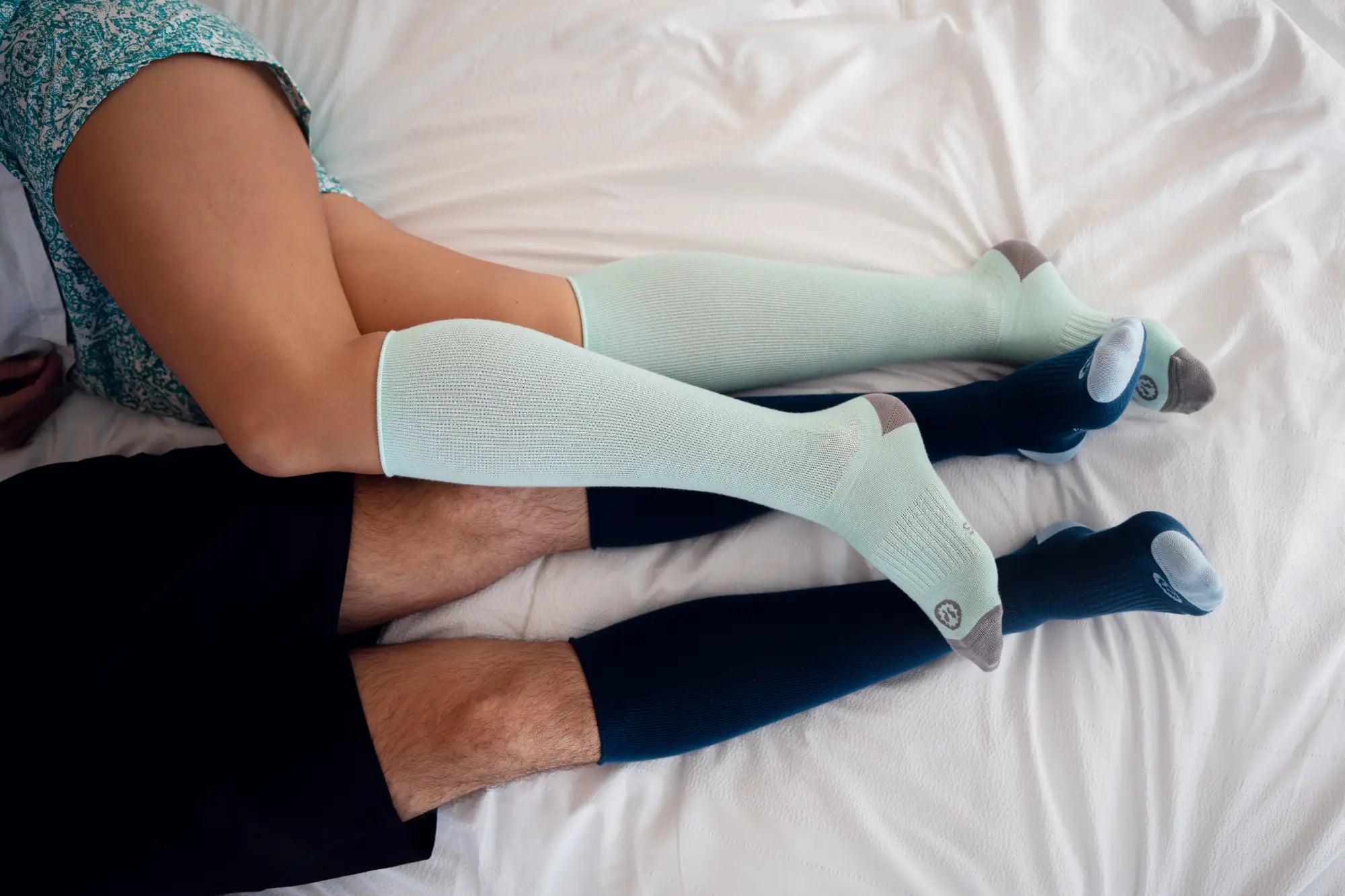
You get into bed after a long day with your compression socks still on, and you can't be bothered to take them off. Does it matter if you fall asleep in them? The short answer is that there is no need: at night they do nothing for you, unless a doctor has told you otherwise. 🧦
Why are they no use at night?
Because of gravity, or rather, because at night it disappears. During the day your blood has to travel uphill from your feet to your heart, fighting against its own weight, and that is where graduated compression lends a hand: it squeezes more at the ankle and eases off towards the knee, so it pushes in the right direction.
When you lie down, that uphill climb becomes flat ground. Your legs are at the same height as your heart and venous return becomes a stroll, so the extra push has nothing left to push.
Is it dangerous to sleep in compression socks?
With light graduated compression and a healthy person, no. But there are situations where it is worth talking to a professional first:
- Arterial circulation problems. If the blood flow down to the foot is already limited, adding hours of pressure while at rest is not a good idea.
- Diabetes or neuropathy. When sensation in the leg is reduced, you may not notice that something is squeezing more than it should.
- Fragile, damaged or very reactive skin. Skin also needs to breathe and be moisturised, and eight hours by day plus eight at night is a lot of hours in a row with fabric on it…
In these cases, it is best to have someone who knows your situation tell you what suits you.
What if the top leaves a mark?
A slight mark when you take them off is normal, just as any sock leaves one. What is not normal is a deep mark that looks like it has been cutting in: that usually means the size is not right for you. It is worth remembering that the size of a compression sock is chosen by the leg, not the foot (the foot does not compress and is always roomy). If in doubt, the size guide shows which measurement to take.
By the way, if the top feels a little loose, it is because Calcetinos deliberately have no tight elastic at the top, so they don't cut off circulation or mark the leg.
Does the answer change depending on the mmHg?
A lot. Saying "compression socks" is like saying "shoes": there are many kinds.
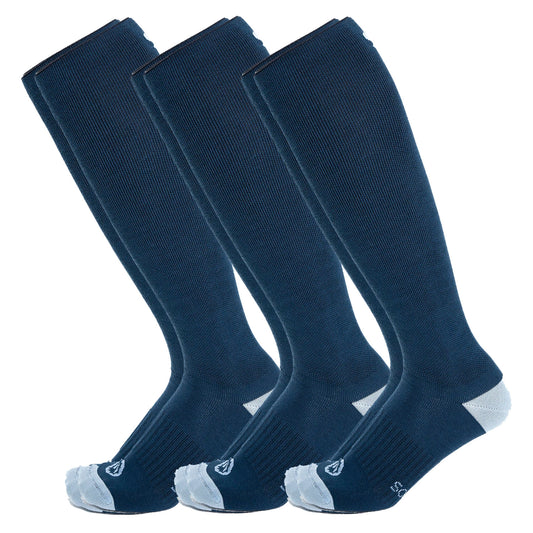
- Light graduated compression, from 14 to 17 mmHg. This is the compression of Calcetinos, designed for everyday wear and to relieve the feeling of tired legs. At night it does nothing, although for a healthy person it is not a problem either.
- Compression from 22 mmHg upwards. That is a different league, with a professional's advice behind it, and whether to wear them at night is up to whoever recommended them.
The 14-17 mmHg of Calcetinos is tested by an external laboratory, which is what makes a figure like that mean something.
What about the studies on sleep apnoea?
They exist, and they are interesting, although they don't say exactly what is sometimes claimed. A small 2015 study found that wearing compression during the day could reduce night-time apnoea symptoms, and the explanation makes sense: if you stop fluid building up in your legs during the day, there is less fluid to redistribute when you lie down at night. In other words, the benefit came from wearing them during the day. The results are not conclusive and it is not a general recommendation.

So when should you put them on?
In the morning, when you get up, before your legs start to swell, and take them off when you go to bed. That is the full cycle, and if you want the detail on hours we cover it in how long you should wear them.
There is one exception we see a lot among our customers: the afternoon nap. A short rest with them on is perfectly fine, especially if you are going to get up afterwards and carry on with your day.
What should I do if my legs ache just as I go to bed?
If the discomfort appears precisely when you get into bed, compression is not the tool. Try this instead:
- Raise your legs. A cushion under your ankles for fifteen or twenty minutes before sleeping.
- Cool water. A jet running from the ankle up towards the knee at the end of your shower.
- Moisturise your skin. With a massage in the direction of circulation, always upwards, etc.
And if the heaviness comes from the heat, we have a whole article on why your legs hurt in summer with more tips.
What if I still prefer to sleep in them?
If you still want to try it and none of the situations above apply to you, we are not going to make a drama of it. But we don't recommend it if you have already worn them all day: lying down, compression does nothing, and your skin appreciates a few hours without fabric on it.
Where you will notice the difference is in those eight or ten hours on your feet, at the office or at the airport. That is where light graduated compression earns its keep, with cotton for everyday wear or bamboo if you have sensitive skin, which is also more breathable than cotton.
If you want to see all their uses, we go through them in what compression socks do.

Because, as you know, not all compression socks are Calcetinos… or the same 😉


2 comments
Estos calcetinos son una maravilla, mi dolor de piernas a desaparecido, nada más usarlos. He probado los standar y los de bambu y ahora voy a pedir los fresh . Estoy encantada con ellos
Siento alivio cuando uso las media compresión. Las estoy usando por qué una amiga me la recomendó.por a ella le pasa lo mismo.y se ciente mejor.usandola por el día