

Which socks should you wear for long hours standing at work?
Light graduated compression socks that reach just below the knee, chosen by your leg measurement and put on before your shift starts.
Calcetinos press more at the ankle and ease off towards the knee, with 14-17 mmHg tested in an external lab. They work with your uniform and your work shoes, and they are made in Spain.
Calcetinos for your workday
All with light graduated compression, reaching just below the knee. Pick the material to suit where and how you work.
- For everyday wear
Regular price 19,95 €Regular priceUnit price per
- Long shifts and sensitive skin
Regular price 24,95 €Regular priceUnit price per
- If you work in the heat
Regular price 24,95 €Regular priceUnit price per
- One of each, to rotate

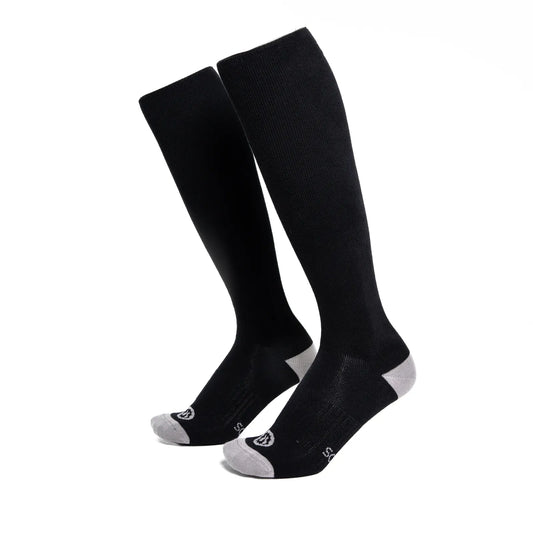 SaleRegular price 46,57 €Regular priceUnit price per
69,85 €Sale price 46,57 €Sale


Why do your legs feel heavy at the end of a day on your feet?
Eight hours behind a bar, along a hospital ward or next to the chair in a hair salon. You get home and your legs feel as if your calves were full of sand, and your ankles look thicker than they did in the morning.
There is a reason for it. Blood in your legs travels back up to the heart against gravity, and your calf does most of the lifting: every time you take a step, the muscle contracts and pushes it up, like a water pump. When you walk, that pump works on its own. When you spend hours standing in the same square metre, it works much less and gravity starts to win: blood tends to stay low and some fluid moves into the tissue around the ankle. That is why the heaviness builds as your shift goes on.

How do compression socks help when you work standing up?
A graduated compression sock presses harder at the ankle and eases off towards the knee. That difference in pressure does part of the job your calf stops doing when you stand still: it helps blood on its way up and makes it harder for fluid to settle low down.
The aim is to finish your shift with lighter legs and with energy for something more than collapsing on the sofa. It is light compression for everyday wear, with no medical prescription needed.
Who are they for?
Anyone whose work is done standing up: healthcare and nursing staff, waiters and cooks, shop assistants and cashiers, hairdressers and beauticians, cabin crew, teachers, warehouse and logistics staff, security guards, factory workers… and a looong list of jobs where sitting down is a luxury.
If it is the other way round and you spend the day in a chair, we have a page for people who spend a lot of time sitting.

How do you choose socks for working on your feet?
Four things decide whether they will see you through the day: pressure, size, material and length. And at work a fifth one matters too: they should not get in the way of your uniform or your shoes.
How much compression do I need?
mmHg measures the pressure the sock applies at the ankle. Calcetinos have between 14 and 17 mmHg, tested in an external laboratory: light compression, designed for the heaviness and tiredness of a long working day when there is no medical indication. You can feel them working, and you can still wear them for a whole shift without discomfort.
There are stockings with much more pressure, and they are usually prescribed by a doctor on a case-by-case basis. If yours has recommended a specific compression, that is the one you need, and it is sold in pharmacies. If you want to understand the figure, we explain it in what mmHg means in compression stockings.
How do I get the size right?
Look at your leg, not your shoe size. Compression works on the ankle and the calf, so that is where you measure; the foot does not compress and stays loose whichever size you choose. There are four sizes, from S to XL, and the size guide shows you how to measure.
At the end of the day, a light mark at the top is normal, as with any sock. If the mark is deep, the kind that looks like it is cutting in, the size is most likely not right for you.
Which material suits my job?
- Cotton, for everyday wear. Basic are the everyday pair and handle a normal working day well.
- Bamboo, if your shifts are long and your skin notices. Nature Bamboo are soft, hypoallergenic and more breathable than cotton. If your skin is reactive, we cover it in socks for sensitive skin.
- Coolmax, if you work in the heat. Fresh are the coolest, for a kitchen, a warehouse without air conditioning or summer behind a bar. You will find all the cool models in summer compression socks.
How high should they go?
Up to just below the knee, which is where the calf ends and where the work of the compression stops. It is also a length that stays hidden under any uniform trousers. All Calcetinos have it.
What about uniforms and work shoes?
They are plain knee-high socks with no patterns, so they go unnoticed with scrubs, chef trousers or a suit. And since they do not squeeze the foot, you can wear them with your usual work shoes, clogs included.

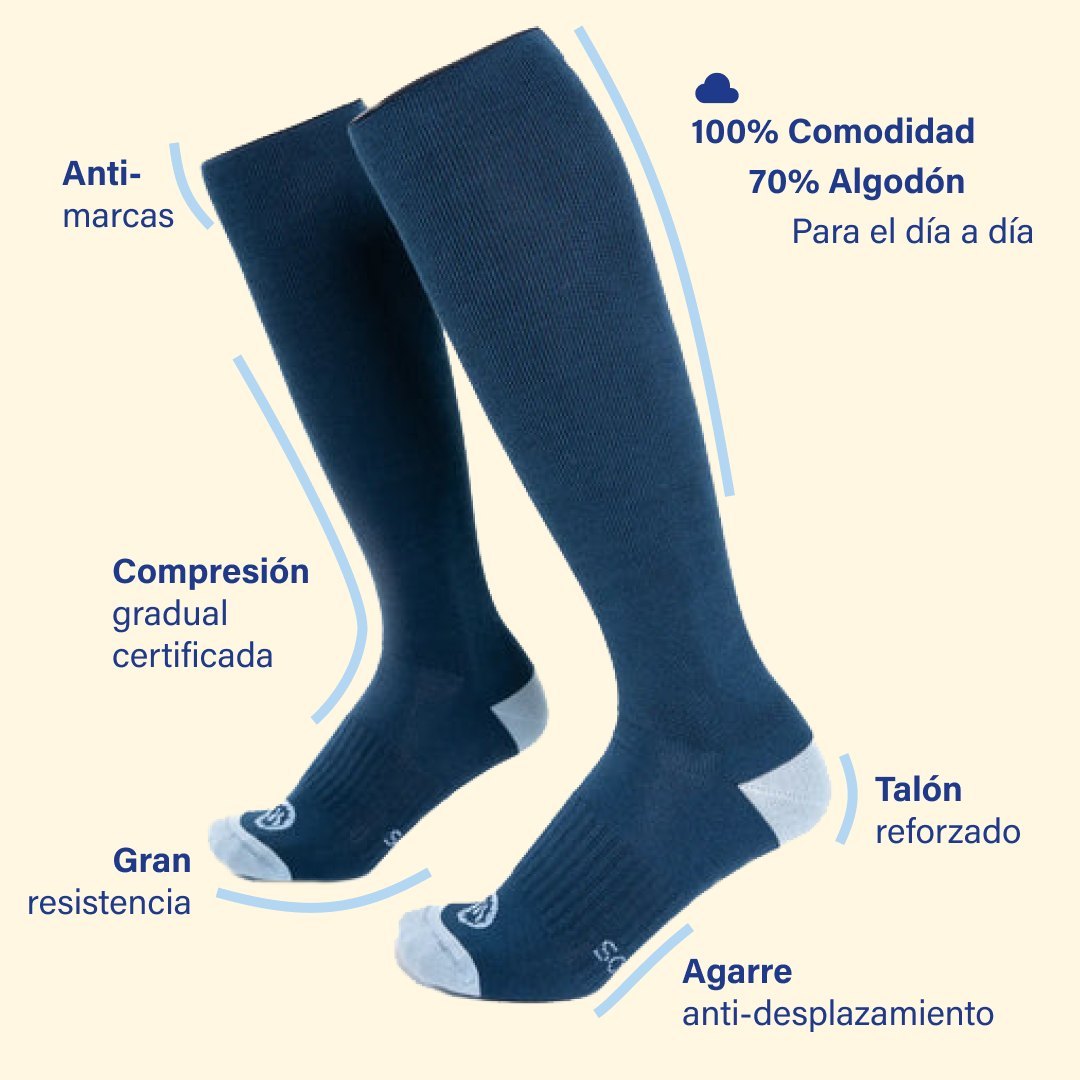
Basic: the everyday pair, for your shift too 🧦
Combed cotton, light graduated compression of 14-17 mmHg and the right length, just below the knee. Made in Spain.
- No tight elastic at the top, so your leg is not marked at the end of the day
- No patterns or raised seams that spoil the compression
- OEKO-TEX Standard 100 certification
What else helps during the working day?
Move whenever there is a gap: shift your weight from one leg to the other, rise onto your toes a few times or take a few steps, which is what gets the calf working. Comfortable shoes that hold the foot without squeezing it. And when you get home, some time with your legs up.
What is behind a pair of Calcetinos?
Calcetinos are light graduated compression socks for everyday wear, made in Spain. The 14-17 mmHg compression is tested in an external laboratory and the fabrics hold the OEKO-TEX Standard 100 certification. We are advised by Dr Erica Homs Romero, a nurse specialising in vascular health and a lecturer in Nursing at the University of Girona.
There are two details that sometimes surprise people, and both are deliberate. There is no tight elastic at the top, so as not to restrict circulation or mark your leg after eight hours, which means that part may feel a little loose. And there are no patterns or raised seams, because they would press on specific points and spoil the graduated compression.
Frequently asked questions about compression socks for standing at work
Which socks are good for standing for many hours?
Light graduated compression socks that reach just below the knee, in the size that fits your leg. They press more at the ankle and less higher up, helping blood on its way back when the calf is barely working. As for the material, it depends on your job: cotton for everyday wear, bamboo if you have sensitive skin and Coolmax if you work in the heat.
Compression stockings or socks for standing at work: which should I choose?
The two words are often used for the same thing, a graduated compression garment up to just below the knee. What matters is the pressure and the length. Stockings that go up to the thigh or waist, with stronger compression, are usually the ones a doctor prescribes. For everyday tiredness with no medical indication, light compression socks up to the knee are the most comfortable to wear with a uniform.
How much compression do I need for standing at work?
If you have no medical indication, light compression like that of Calcetinos, 14-17 mmHg, is enough for the tiredness of a working day. If your doctor has prescribed stronger compression, that is bought at the pharmacy. We explain it in compression stockings: pharmacy or online.
How many hours can I wear them? Should I put them on before my shift starts?
The whole working day. It is best to put them on in the morning, before your legs start to feel heavy, and take them off when you get home or before going to bed. You will find the hours for each use in how long to wear compression socks.
Do they work if I work in the heat?
Yes. For a kitchen, a bakery or a warehouse in summer, Coolmax Fresh are the coolest, and Nature Bamboo also breathes well. You will find them together in summer compression socks.
Do they help with foot pain?
Compression works on the leg: Calcetinos do not squeeze the foot. If the pain is in the sole or the toes, footwear and the way you walk matter most, and if the pain does not go away it is worth seeing a podiatrist. What they can do is help you reach the end of your shift with less tired legs. If the front of your foot bothers you, you may be interested in our post on socks for Morton's neuroma.
Do they help prevent varicose veins if I work standing up?
We cannot promise they will prevent varicose veins. What they do is support circulation and ease the heaviness of spending the day on your feet. If you are interested in what is in your hands, we cover it in how to prevent varicose veins. And if you already notice prominent veins that hurt or swelling that does not go down with rest, talk to your doctor.
When should I not wear them, or when should I see a doctor?
If you have a diagnosed circulation or skin problem, or diabetes, ask your doctor first which compression suits you. And if one leg suddenly swells, hurts or changes colour, see a doctor as soon as possible.
How many pairs do I need if I work five days a week?
Two or three pairs will do: one on, one in the wash and one spare. The 3-for-2 packs are good value, and the Savings Pack Mix 4 includes one cotton, one bamboo and one Coolmax pair so you can see which suits you best.
Have a good shift, and remember that not all compression socks are Calcetinos… or equal 😉
This content is for information only and does not replace the advice of a healthcare professional.
Long shift tomorrow?
Measure your leg with the size guide, pick the material that suits your job and wear them on your next shift.