You arrive home, kick off one shoe with the heel of the other, and that first step on the floor of the entryway feels glorious. Your toes are free, the sole of your foot touches something cool, and your foot, finally, stops being boxed in.
So the question makes sense: is it good to walk barefoot at home? For most healthy feet, yes, and we’re going to see why. But there are floors, times of year, and specific feet for which it is better to wear something, and there is another part of the body, the leg, that has very different needs than the foot.
Let’s start with what happens down there when you take off your shoes.
Is it good to walk barefoot at home?
Try buttoning your shirt while wearing ski gloves. You can do it, but your fingers are groping because the thick fabric doesn’t let them feel what they are touching. The same thing happens to the foot inside a thick-soled shoe: it keeps doing its job, but with less information.
And that information matters more than it seems. The sole of the foot is full of tiny sensors in the skin that detect where you are placing your weight at any given moment. Did you know that your brain uses this pressure map to keep you upright? In a classic experiment, it was enough to gently vibrate the front or back of the sole for people standing to lean their whole body in the opposite direction, correcting for a pressure that didn't actually exist1. That is proprioception (the body's ability to know what position it is in without having to look at it), and the sole of the foot is one of its sources.
Barefoot, that map reaches the brain with more detail. A 2025 review on walking barefoot notes that this extra sensory stimulus promotes balance and stability when walking2.
What does the foot gain when it goes barefoot?
Besides feeling more, it works more. The foot has a small and intrinsic musculature (muscles that originate and end within the foot itself and support the arch), and inside a very rigid shoe, those muscles can afford to take a break.
A Brigham Young University trial measured this in a very graphic way: a group of runners gradually replaced their usual footwear with minimalist footwear, the closest thing to being barefoot that you can wear, without doing any special exercise. At eight weeks, their foot muscles had gained size and strength, just like those of another group that did specific strengthening exercises, while the group that continued with their usual footwear stayed the same3.
Now, just because it’s good doesn't mean it performs miracles. A systematic review that gathered fifteen studies on populations that habitually walk barefoot found some differences, such as wider feet, but concluded that evidence on long-term effects is still limited4. Walking barefoot at home is a good habit for your feet. You just shouldn't expect it to change your life.

When is it better not to walk barefoot at home?
This is where the "yes" from before needs its fine print. There are quite common situations where it is sensible to put something on your feet:
- Polished floors and stairs. The bare foot has better grip than you think. In a study on hospital vinyl flooring, the bare foot took the longest to slip, more than any sock, including those sold as non-slip5. The reason is simple: between the skin and the floor there is a layer of fabric that slides. So if your house has polished tile, wooden stairs, or you are going to move in a hurry, just a sock is not a good idea: either barefoot or with a house slipper with a sole.
- If you have diabetes. With diabetes, foot sensitivity can decrease, and a small wound that goes unnoticed can become complicated. That is why the CDC, the United States' public health agency, recommends that people with diabetes not go barefoot, even inside the house6.
- If you have a diagnosed foot condition. With plantar fasciitis, for example, walking barefoot on hard floors can put pressure exactly on the area that hurts. In that case, the decision is up to your podiatrist, and in our post on socks for plantar fasciitis, we explain why it is also advisable to wear shoes at home in that case.
- Floors with surprises. The bathroom renovation halfway finished, the glass that broke this morning, the child's building block hidden in the rug…
And one more, out of common sense: if you haven't taken off your shoes except to sleep for years, start with short periods. Those small foot muscles have spent a long time working very little, and, like any unaccustomed muscle, they will get strained if you demand a full day of it all at once.
Does walking barefoot cause colds?
It’s the classic saying, and it has its grain of truth and its myth. The myth part: colds are caused by viruses7, and the cold floor isn't going to give you one.
The truth part is more curious. At Cardiff University, they put the feet of ninety volunteers in cold water for twenty minutes and compared them with another ninety who didn't go through the tub. In the following days, 13 people from the cold-foot group developed cold symptoms, compared to 5 from the other group8. The explanation proposed by the authors is that cold feet narrow the blood vessels in the nose, and that can give an advantage to a virus that was already there waiting for its opportunity.
In other words: the cold doesn't bring the virus, but if you were already incubating one, it can speed up the process. So in the middle of January, with the floor frozen, putting something on your feet makes sense.
And what if my feet get freezing cold at home?
If it happens to you often, even if the house is warm, it is worth looking at the reason, which can range from circulation to how you dress. We review this in our post on cold feet: causes and solutions.
Is it good to walk barefoot with socks?
It is one of the most repeated questions on this topic, and the answer has two parts, because we are actually talking about two different areas of the body.
For the foot, a thin sock is a middle ground: it feels the floor significantly better than inside a rigid sneaker, but somewhat less than being bare, because the fabric cushions part of the information sent by the sensors on the sole. And we have already seen that on smooth floors it slips more.
For the leg, the conversation is different. Your leg doesn't need to feel the floor. What it needs is for the blood that has traveled down to the ankles to return up toward the heart, and that is harder when you spend hours still, whether in your work-from-home chair, on the sofa, or standing in front of the kitchen stove.
Think of a tube of toothpaste. If you squeeze in the middle, the paste spreads in both directions. If you squeeze from the bottom and go upward, it all comes out the top. Gradual compression works with that logic: it squeezes a little more at the ankle and loosens toward the knee, so it is easier for the blood to rise than to stay down. If you want the details, we cover them in how gradual compression works.
That is why walking barefoot and wearing compression socks don't compete. The bare foot exercises the foot, and light compression supports the leg.

Do compression socks squeeze the foot?
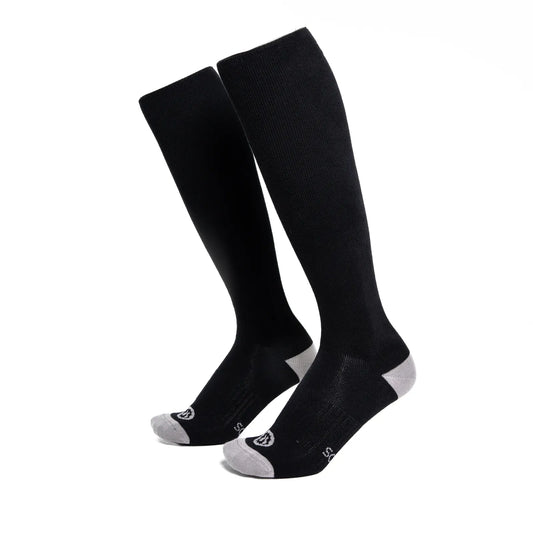
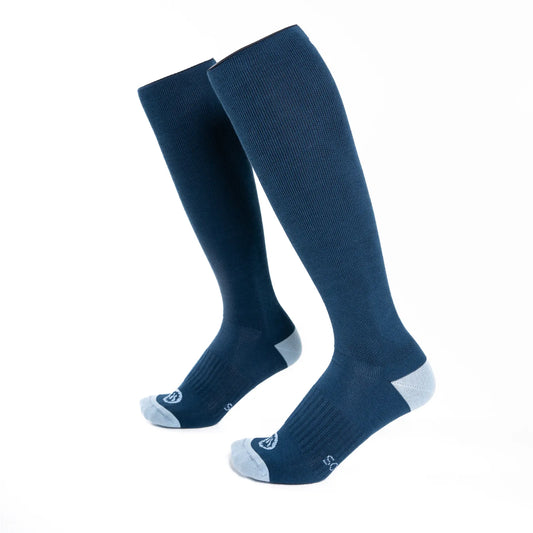
Ours don't. In a pair of Calcetinos, the foot is not compressed: it remains loose, with the toes free to move, no matter which size you choose. The compression is where it is needed, on the leg, firmer at the ankle and loosening upward. Therefore, if you are worried that the sock will take away the freedom the foot gains from being barefoot, you can rest easy: the foot remains at ease, and the work is done by the part of the leg that spends hours still.
That also explains why the size is chosen by looking at the calf and not the shoe size: it is the leg that must receive the correct pressure. The measurements are in the size guide.
Two other details that go along the lines of not squeezing where it shouldn't: they don't have tight elastic at the top, to avoid marking or strangling the leg below the knee, and they don't have patterns or raised seams, because every one of those seams squeezes a specific point and disrupts the gradual compression.
And so no one is misled: Calcetinos are wellness socks with light gradual compression of 14 to 17 mmHg, tested in an external laboratory. They are not a medical product nor are they funded by prescription, and they do not replace the advice of a professional if you have a circulation problem.
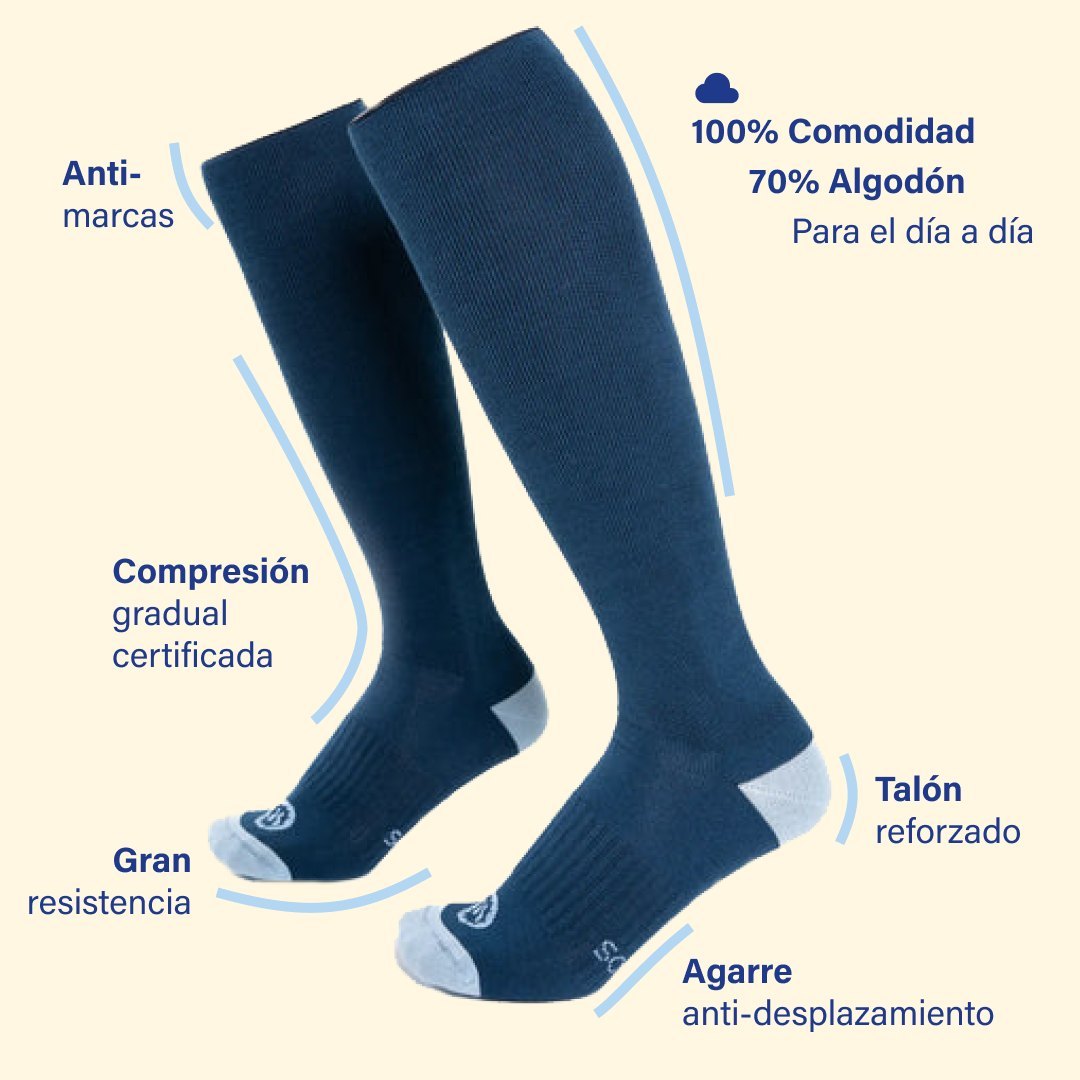
🧦 Basic: combed cotton for time at home
Light gradual compression of 14 to 17 mmHg verified in an external laboratory, in combed cotton, for hours of teleworking, lounging on the sofa, or cooking when the leg spends a long time still.
- Loose foot, compression on the leg
- No elastic that squeezes at the top and no raised seams
- OEKO-TEX Standard 100 certified and made in Spain
Light gradual compression for daily wellness support. They are not a medical product.
If you have sensitive or atopic skin, Nature Bamboo are the softest in the family and are more breathable than cotton.
How to combine going barefoot and wearing Calcetinos at home?
There is no need to choose. A reasonable way to split the day:
- When moving, go barefoot. Cleaning up, going back and forth in the hall, stretching on the rug. This is when the foot makes the most of contact with the floor, provided the floor is safe.
- When still, wear Calcetinos. A morning teleworking in your chair or an afternoon watching a series on the sofa. If you spend many hours sitting, in our post on swollen legs from sitting, you will also find a few tips to move your legs without getting up.
- On polished floors or stairs, wear house slippers over them. The sock does its job on the leg, and the sole provides the grip.
And if one winter day you just don't feel like taking them off all afternoon, that works too. Your feet will have their free time tomorrow.
Frequently asked questions
How much time is it good to walk barefoot at home?
There is no fixed number that applies to everyone across the board. If you aren't used to it, start with short periods and lengthen them as long as your feet don't protest. If pain appears in the sole or heel that doesn't go away after a day or two, stop and consult a podiatrist.
Is it bad to walk barefoot at home every day?
For a healthy foot and on a safe floor, no. The exceptions are the ones we've seen: diabetes, diagnosed foot pain, slippery or very cold floors. In those cases, it is better to have something on your feet.
Does walking barefoot widen the foot?
Populations that habitually walk barefoot have, on average, slightly wider feet than those who wear shoes. This has been observed in people who have lived like that their whole lives, so walking barefoot at home for a while is not going to change your shoe size from one month to the next.
Is it bad to walk barefoot at home in winter?
A cold floor won't give you a cold, but cooling your feet down significantly can help bring out one you were incubating. In cold months, especially with tile floors, it is reasonable to wear something on your feet.
Can I walk barefoot if I have plantar fasciitis?
While it hurts, it is usually recommended to wear shoes at home as well, with a slipper that supports the heel. Whatever your podiatrist tells you is what you should follow.
Notice: informative content, it does not replace the assessment of a health professional.
So, barefoot or with socks?
Both things, each at its own time. Barefoot when the foot can enjoy the floor, and with Calcetinos when the leg is still and appreciates a little help to get the blood flowing back up.
If you want to see all the models together, you have them here:
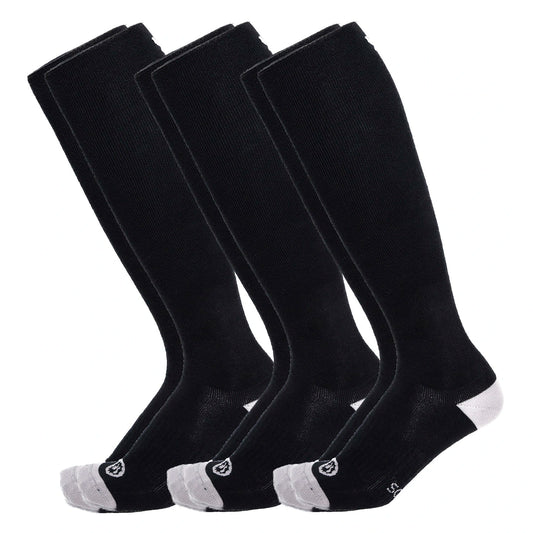
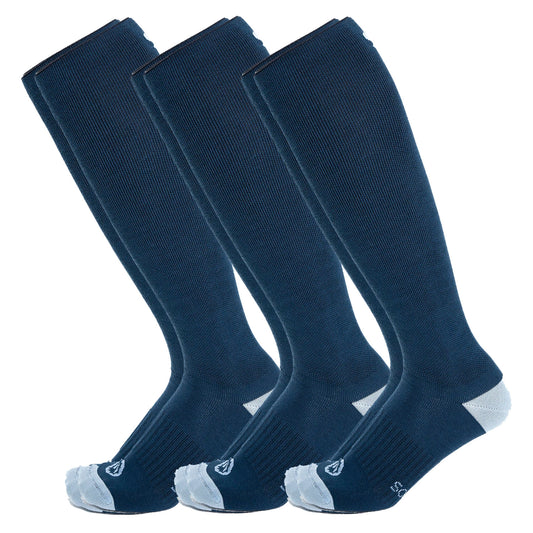
And if there are several of you at home with heavy legs at the end of the day, you get a better deal with a pack:
Let the foot do its own thing. Let the leg be well cared for. Remember that not all compression socks are Calcetinos… nor are they the same 😉
Sources
- Kavounoudias A, Roll R, Roll JP. The plantar sole is a “dynamometric map” for human balance control. NeuroReport. 1998;9(14):3247-3252. Available at: doi.org/10.1097/00001756-199810050-00021
- Derzsi Z. Walking barefoot: a literature review of sensory, biomechanical aspects and injury risks. Medical Research Archives. 2025;13(12). Available at: esmed.org/MRA/mra/article/view/7126
- Ridge ST, Olsen MT, Bruening DA, Jurgensmeier K, Griffin D, Davis IS, Johnson AW. Walking in Minimalist Shoes Is Effective for Strengthening Foot Muscles. Medicine & Science in Sports & Exercise. 2019;51(1):104-113. Available at: pubmed.ncbi.nlm.nih.gov/30113521
- Hollander K, Heidt C, van der Zwaard BC, Braumann KM, Zech A. Long-Term Effects of Habitual Barefoot Running and Walking: A Systematic Review. Medicine & Science in Sports & Exercise. 2017;49(4):752-762. Available at: pubmed.ncbi.nlm.nih.gov/27801744
- Chari S, Haines T, Varghese P, Economidis A. Are non-slip socks really “non-slip”? An analysis of slip resistance. BMC Geriatrics. 2009;9:39. Available at: doi.org/10.1186/1471-2318-9-39
- Centers for Disease Control and Prevention. Diabetes and Your Feet.
- NHS. Common cold.
- Johnson C, Eccles R. Acute cooling of the feet and the onset of common cold symptoms. Family Practice. 2005;22(6):608-613. Available at: pubmed.ncbi.nlm.nih.gov/16286463