It's seven o'clock, you close your laptop, and you stand up from your chair. Your first steps feel heavy, your shoe feels tighter than this morning, and when you pull down your sock, you see that line marked above your ankle. The strange thing is you haven't walked at all today.
Well, there's the explanation. Legs swell from sitting precisely because they don't move: the calf is responsible for pushing blood back up, and eight hours in a chair leaves it doing nothing.
Let's see what exactly happens down there, how long it takes to notice, and what you can do from your own chair without setting up a gym under your desk.
Why do your legs swell if you spend all day sitting?
Think of the manual water pumps in village squares, the lever ones. As long as someone pumps the handle up and down, water comes out. As soon as they get tired and let go, the stream stops.
Your calves are that lever. Every time the calf muscle contracts when walking, it flattens the deep veins that run through it and pushes blood back towards the heart; when it relaxes, it creates space and draws blood from the lower part of the leg. When walking, the lever goes up and down all the time without you having to think about it. When sitting, it stays still, and gravity keeps the blood pooling at the bottom.
And this can be measured: In a study published in 2024 with 27 healthy volunteers, an entire day spent sitting in a normal office posture caused the foot to gain about 14 ml of volume, about 3% more than in the morning1. Fourteen milliliters is three teaspoons of fluid that wasn't there in the morning. It doesn't seem like much when written, but it's exactly the difference between a shoe fitting well and not.

How long does it take for your leg to notice prolonged sitting?
Much less than you imagine. In another study, measuring the calves of middle-aged adults while sitting, the circumference had already increased noticeably after one hour, and after two hours, participants reported more tension, swelling, heaviness, and numbness in the leg2.
Translated to your schedule: if you start at nine, by mid-morning your leg has already started counting. The long meeting after lunch just finishes the job.
Are your feet or legs swelling?
It's worth separating them, because the solution is not the same. The ankle and instep are where it first shows, because fluid seeks the lowest point, and there the skin is thin and there's no muscle to hide it. The calf also gains volume, but since it's wrapped in muscle, it's felt more as a sensation than as a shape: heavy leg, tightness, desire to stretch it.
The distinction matters for a practical reason: the shoe that feels tight at six o'clock is about your foot. The feeling of a heavy leg and the sock mark are about your leg, and that's where adequate compression works: in a compression sock, the foot is always loose, it doesn't compress at all (you'll appreciate this).
If you're looking for the complete picture of causes, beyond just sitting, we break it down in the post about why legs swell.
How to avoid swollen legs without setting up a gym under your desk?
- Move your foot even if you don't stand up. A team from the University of Missouri had a group of volunteers sit for three hours, moving one foot for one minute out of every five, with the other leg completely still. In the leg that moved, popliteal artery flow increased; in the still leg, it decreased3. Tapping your foot under the table isn't elegant, but no one sees it. Some prefer to buy one of those pedal devices for moving their feet while sitting: they work for the same reason, because they force the calf to contract, and they have the advantage that you don't forget to use them. But, of course, it's a bulky... unsightly, and dependent on an external, expensive, and heavy structure (meaning, we don't recommend it...).
- Elevate your feet for a while. In the foot volume study, the side that spent the day elevated not only didn't swell: it decreased by about 6 ml1. A footrest, a box of files, or an overturned wastebasket serve the same purpose.
- Stand up before two hours pass. Taking a phone call standing up, getting a glass of water, walking to the printer that's far away instead of the one next door. Any excuse works, because what counts are the calf contractions, not the meters.
- Check the edge of your chair. If the seat cuts you off just behind the knee, or leaves your feet dangling without support, your leg will suffer more. Make sure the sole of your foot reaches the floor or the footrest.
- The walk after lunch. Ten minutes of walking gives your calf more movement than it will get all afternoon during the workday.
And so on, with whatever else you can think of. A couple of these are enough: the important thing is that the lever doesn't stay still for three hours.

What if I get home with swollen legs after work?
This is when most people write to us: it's eight o'clock, you take off your shoes, and there's the ankle. The best thing to do at that time is the opposite of what you've been doing all day.
Walk for a while before sitting down, even if it's just to get bread. Then, twenty minutes with your legs elevated, higher than your heart: on the sofa with two cushions under your calves, or directly with your feet against the wall. And avoid standing still in the kitchen, which is almost as bad for your legs as sitting.
By morning you should have started from scratch again. If not, refer to the section below on when to consult a professional.
Is crossing your legs at the office bad?
It's the star question, and the answer we can give you right now is that there's no solid study linking crossing legs to the appearance of varicose veins (at least, not that we know of). What has been measured is the other thing: stillness. You can uncross them every five minutes and end the day with equally swollen legs if you don't move them all afternoon.
Changing posture often is beneficial, of course. The posture that takes its toll is the one that lasts three hours straight, whatever it may be.
And what role do compression socks play here?
If the problem is that the calf isn't pushing, it makes sense to give it a hand from the outside. That's what gradual compression is: the sock squeezes a bit more at the ankle and gradually loosens as it goes up towards the knee, making it easier for blood to go up than down. A constant little help during the hours when your leg isn't helping itself.
It's worth saying what they are not, so no one is disappointed: they are not a treatment and do not replace movement. They are a well-being support while you are still. If you want to understand what the numbers you see on the labels mean, we explain it in what mmHg means in compression stockings.
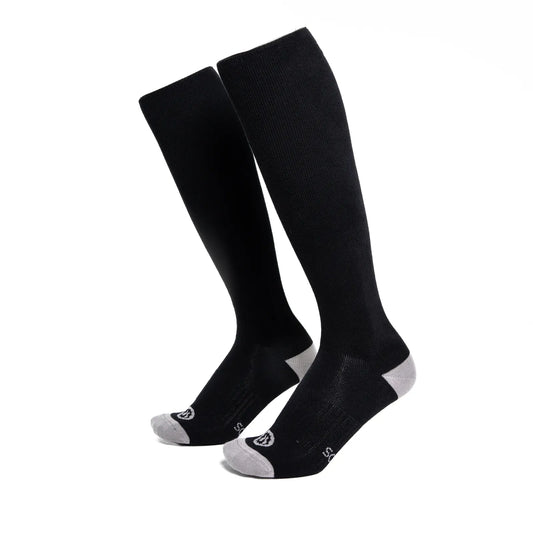
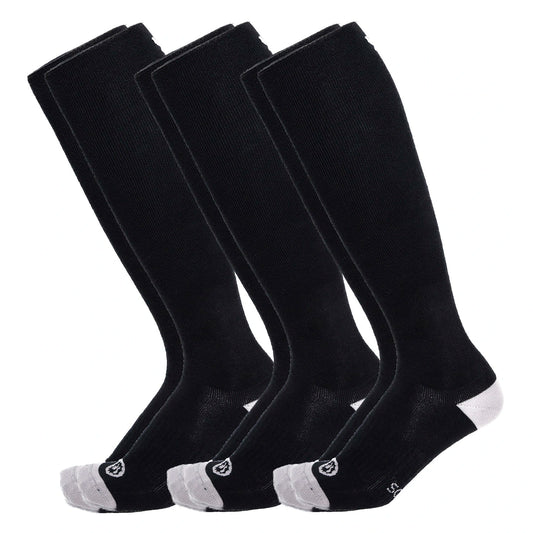
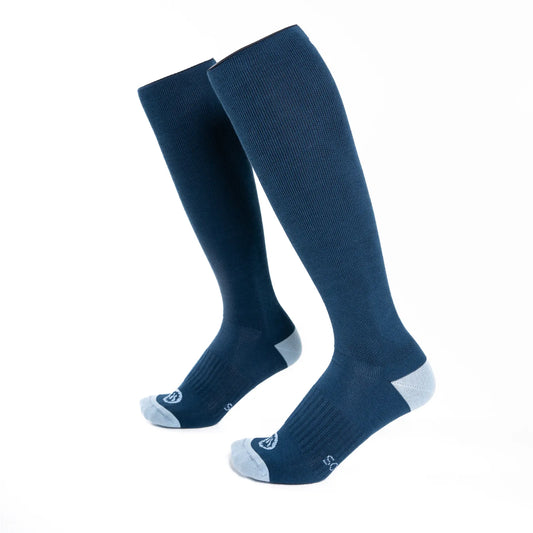
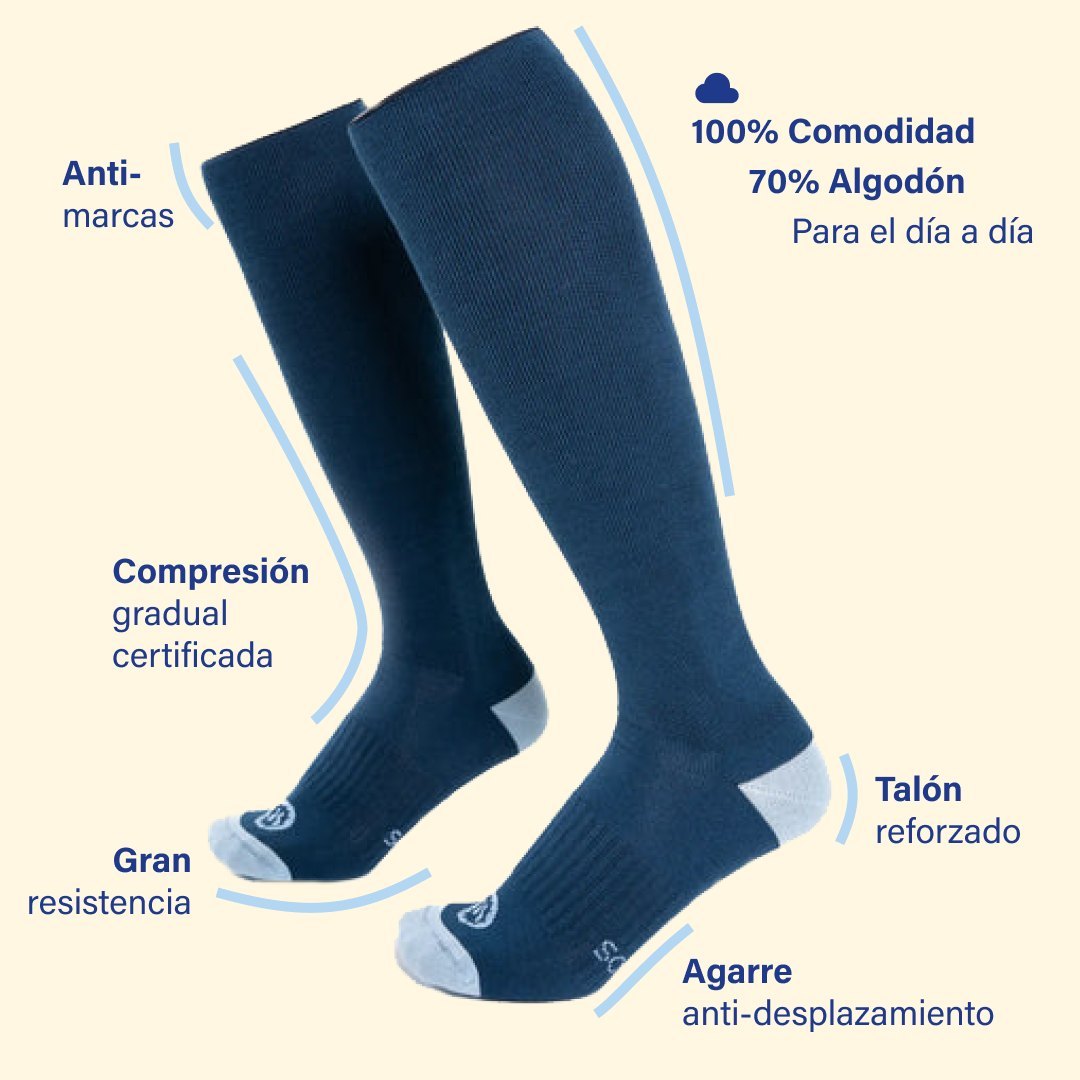
Our Calcetinos feature light gradual compression from 14 to 17 mmHg, tested in an external laboratory, OEKO-TEX Standard 100 certified, and are manufactured in Spain. And they have a couple of details that surprise those coming from other brands:
- The top part doesn't squeeze. This is intentional. It doesn't have a strong elastic, because an elastic that constricts below the knee ruins exactly what we're trying to do. That's why it sometimes feels a bit loose at the top: it's a deliberate design, not a defect.
- They don't have patterns or raised seams. Every raised seam squeezes at a specific point and disrupts the gradual compression. We prefer a plain sock and intact compression.
- If you feel an itch in your leg when you put them on, good sign: it's the blood getting moving.
- A faint mark when you take them off is normal, like with any sock. A deep, constricting mark is not: it almost always means the chosen size was not yours.

And regarding the size, the most common mistake: it's chosen by the leg, not by the foot. The determining measurement is the calf circumference, because that's where the sock needs to distribute pressure. Your foot size doesn't tell you any universal truth in this matter. You have the measurements in the size guide, and it's worth taking five minutes with a tape measure.
🧦 Basic: combed cotton for eight hours in a chair
Light gradual compression from 14 to 17 mmHg verified in an external laboratory, made of combed cotton, for wearing all day under work pants without remembering you have them on.
- Firmer at the ankle, loosening towards the knee
- No constricting elastic at the top and no raised seams
- OEKO-TEX Standard 100 certified and made in Spain
Light gradual compression for daily well-being support. Not a medical product.
If your office turns into a sauna in July, check out the Fresh from Coolmax, which are more breathable. And if you have sensitive or atopic skin, the Nature Bamboo are the softest in the family.
By the way, if you also travel for work, the mechanism of swollen legs on a long flight is a close relative of this: we explain it in the post about what "economy class syndrome" is and how to avoid it.
On a plane, everything we've talked about comes together: narrow seat, little desire to get up and bother the person next to you, and four hours without moving your calves. In that situation, you put on the socks at home, before leaving for the airport, and take them off when you arrive. We break it down on the page about compression socks for air travel.

When does this swelling stop being normal?
End-of-day swelling has a fairly recognizable signature: it appears in both legs, increases as the day progresses, and by morning you've started over from scratch. When any of these three things change, it's worth having a professional look at it:
- If only one leg swells and the other remains as usual.
- If it appears suddenly, with calf pain, warmth, or redness.
- If it doesn't go down by morning and you wake up with your leg the same as when you went to bed.
- If it's accompanied by shortness of breath, skin color changes, or wounds that are slow to heal.
None of this automatically means anything serious. They are, simply, situations where a twenty-minute consultation saves you months of doubt.
Disclaimer: informational content, does not replace the assessment of a healthcare professional.
Where to start tomorrow?
With the cheapest options: moving your foot under the desk while reading emails, standing up before two hours pass, and elevating your feet on a footrest for a while in the afternoon.
And now the honest part, which also needs to be said: all that works on the days you remember. There will be weeks when you have three meetings back-to-back, a deadline coincides with an unexpected event, you look up and it's half past seven with the feeling of having not moved a leg since ten. It happens when your mind is elsewhere, and the first thing that falls off the list is always what isn't screaming for your attention.
That's where a pair of Calcetinos earn their keep, and it's the compelling reason to have them: you don't have to remember them. You put them on at eight in the morning with the rest of your clothes and they do their job all day long, in the meeting that runs long, on the afternoon flight, and in the dead time in the waiting room. The gradual compression supports your leg precisely during the hours when you're not going to move it, and it doesn't depend on your schedule or your memory. That's all they promise, and for a bad week, that's quite a lot.
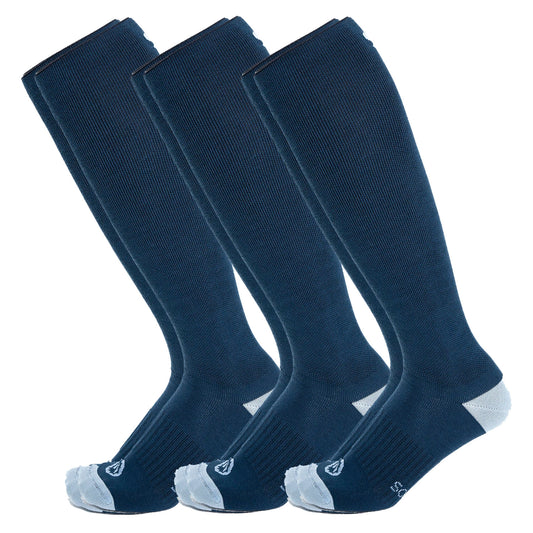
If you want to see them all together and decide calmly, you can find them under compression socks.
You won't change eight hours in a chair tomorrow. What you can change today is what your leg wears in the meantime. And remember that not all compression socks are Calcetinos... or alike 😉
Sources
- Freund W, Wikstroem P, Wunderlich AP, Schuetz U, Beer M. Sitting foot: posture dependent changes of volume, edema and perfusion of the foot. A prospective interventional study with 27 volunteers. BMC Musculoskeletal Disorders. 2024;25:858. Available at: doi.org/10.1186/s12891-024-07971-4
- Okino K, Aoki M, Yamane M, Kataoka Y, Nitta A, Kohmura C. Prolonged Sitting Causes Leg Discomfort in Middle Aged Adults: Evaluation of Shear Wave Velocity, Calf Circumference, and Discomfort Questionaries. Journal of Clinical Medicine. 2022;11(14):4024. Available at: doi.org/10.3390/jcm11144024
- Morishima T, Restaino RM, Walsh LK, Kanaley JA, Fadel PJ, Padilla J. Prolonged sitting-induced leg endothelial dysfunction is prevented by fidgeting. American Journal of Physiology-Heart and Circulatory Physiology. 2016;311(1):H177-H182. Available at: pubmed.ncbi.nlm.nih.gov/27233765