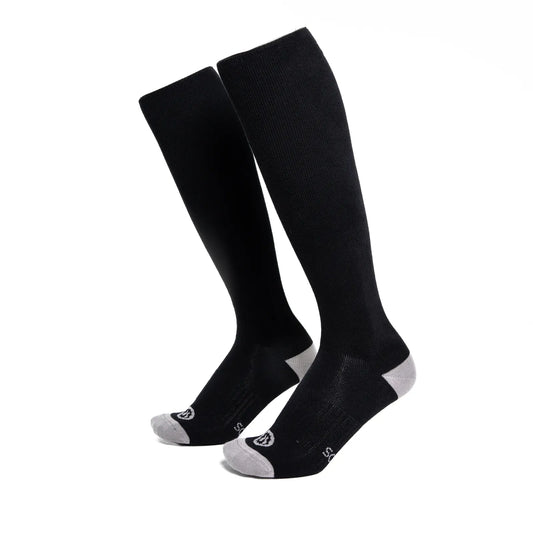
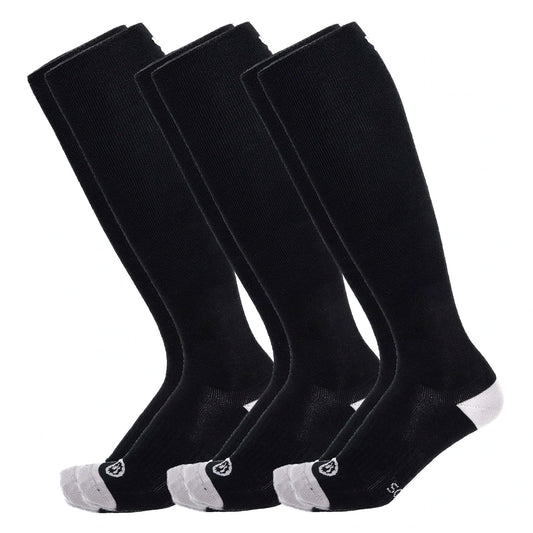
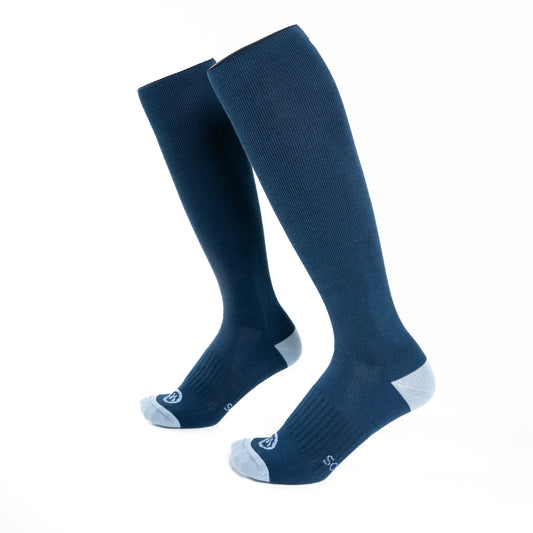
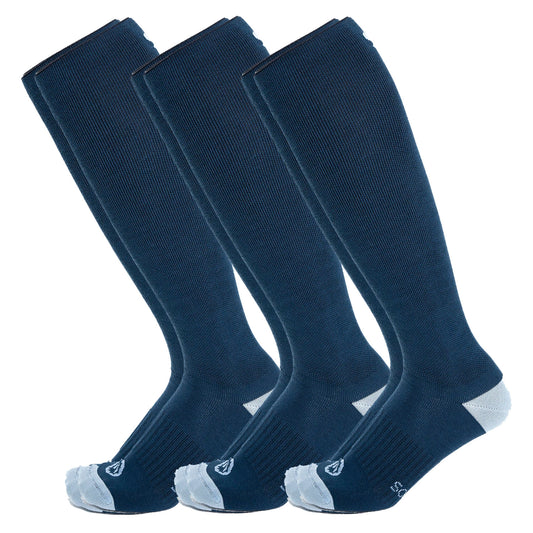
Basoas is a compression sock brand that, according to its website as of November 3, 2026, sells three models: one at 20-30 mmHg, one bamboo model at 15-20 mmHg, and one short model at 12-14 mmHg. Even before looking at reviews (from their own customers and from any brand), it is worth knowing which level of compression you are looking for.
You may have seen an ad, your legs may feel heavy by the end of the day, and you may want to know what those who have already tried them think before buying. That is only sensible.
We say it from the very first line: we are Calcetinos, another compression sock brand, so we are not impartial. That is why here you will only find data that you can check yourself on each brand's website, with the date on which we consulted it, and what each one states about its product. The decision is yours.
What socks does Basoas sell and what compression does each one claim?
According to their catalog and product pages, consulted on November 3, 20261:
- Basoas Compression Socks. This is their main model, a knee-high sock, and its product page states a graduated compression of 20-30 mmHg.
- Bamboo Compression Sock. Also a knee-high sock, made with bamboo fabric, and its product page states 15-20 mmHg.
- Short Compression Sock. A short format, with 12-14 mmHg stated at the foot and ankle. Since we at Calcetinos do not make a short sock, we leave it out of the comparison.
The two knee-high models are sold in sizes S/M, L/XL, and XXL, which according to their size guide correspond to EU shoe sizes 35 to 47 and a calf circumference of 22 to 51 cm. The main model also advertises a size 3XL.
With this you already have the first clue: not all Basoas socks apply the same pressure, and reading reviews of a 20-30 mmHg model is not the same as reading reviews of a 15-20 mmHg one.
What reviews does Basoas have?
On its own website, as of November 3, 2026, the main model has 575 ratings, with an average of 4.70 out of 5, and the bamboo model has 284 ratings, with an average of 4.32. The product page itself indicates that these reviews are collected through an invitation from the store or in the Shop app1.
The stars tell you how many people have reviewed and how satisfied they are overall. To know if a sock will work for you, what matters is what is inside each review.
What to look for in a compression sock review?
- The size they chose. A compression sock that is too tight, or that slides down, is often a poorly chosen size. If the review mentions it, it is twice as useful.
- What they use it for. A day on your feet in a kitchen is not the same as a three-hour flight or a bike ride.
- How long they have worn it. A review written on the first day speaks to the first impression. One written after several months also tells you how well the fabric holds up to washing.
- Whether it is a verified purchase. When the store shows that the reviewer bought the product, what they say carries more weight.
You can find all of Calcetinos' reviews on our reviews page: as of November 3, 2026, there are 332 reviews with the verified purchase badge, with an average of 4.8 out of 5.
Basoas or Calcetinos: how do they differ?
To see it at a glance, here is the data each brand publishes about its knee-high socks:
| Basoas, according to its website | Calcetinos | |
|---|---|---|
| Stated compression | Main model: 20-30 mmHg. Bamboo model: 15-20 mmHg | 14-17 mmHg in all models, tested in an external laboratory |
| Knee-high models | Two: the main one and the bamboo one | Four: Basic in combed cotton, Nature in bamboo, Dynamic in polyamide with reinforced sole, and Fresh in Coolmax |
| Sizes | S/M, L/XL, and XXL: EU shoe sizes 35 to 47, calf 22 to 51 cm | S, M, L, and XL: EU shoe sizes 36 to 46, calf 32 to 45 cm |
| Shipping | Free from a minimum order amount | Free on all orders to mainland Spain, delivered to your mailbox |
| Return period | 14 calendar days for withdrawal, plus a 60-day satisfaction guarantee from the date of purchase | 10 business days from the date you receive the order |
| Ratings on its website | 575, average of 4.70 for the main model; 284, average of 4.32 for the bamboo model | 332 with verified purchase, average of 4.8 |
Data consulted on November 3, 2026, on each brand's website1, 2. If anything has changed since then, the information on each product page takes precedence.
Where does Basoas come out ahead?
In several ways, and it is worth saying:
- If you are looking for higher compression, its main model states 20-30 mmHg. We deliberately stick to light compression, and in the next section we tell you why.
- It covers more sizes. Its size guide goes up to a 51 cm calf and EU shoe size 47, above our XL.
- More time to return, with that 60-day satisfaction guarantee on top of the 14 legal days.
- More colors in the bamboo model, and free-pair promotions on its product page.
What data should you look for on any product page?
Beyond the stars, a compression sock product page should tell you a few things:
- How many mmHg and who measured them. A specific number, preferably verified by an independent laboratory, is worth more than "medium compression".
- The composition, in percentages. What the fabric is made of and in what proportion.
- Where it is made. It is part of knowing what you are buying and who is behind it.
- The fabric certification. You will be wearing it against your skin for many hours.
- A size guide based on the leg, with the calf circumference and not just the shoe size.
Not all brands publish the composition in percentages or where they make their socks. At Calcetinos, we put it on every product page: our socks are made in Spain, the compression is tested in an external laboratory, and the fabric has the OEKO-TEX Standard 100 certification, which guarantees that it is free of harmful substances.
What compression do you need: 20-30 or 14-17 mmHg?
This is the fundamental difference between the two brands, and the one you most need to be clear about before buying.
Think of sunglasses and prescription glasses. Both protect your eyes, but prescription glasses are fitted to you by the optician, while you choose sunglasses based on the light you will have. Something similar happens with compression.
- Light compression, below 20 mmHg, is for daily well-being: tired or heavy legs at the end of the day, many hours standing or sitting, long trips, coming back from a ride... That is where Calcetinos are, with 14-17 mmHg.
- From 20-30 mmHg you enter the pressure levels that a doctor sets when prescribing compression stockings. In the Michigan Medicine patient guide, for example, 20-30 mmHg is the first of those levels3. More pressure is not better on its own: compression that is not right for you, or that fits poorly, may be uncomfortable or not give you what you are looking for.
That is why, if your doctor has prescribed strong compression, follow their instructions, and in our post on buying compression stockings at the pharmacy or online we explain how that case works. And if what you are looking for is light compression for everyday use, or your doctor has recommended it, you can find it online in our compression socks. Calcetinos is not a medical device and is not available on prescription.
One more thing: comparing isolated figures between brands has its pitfalls, because two different scales coexist, the European one by class and the Anglo-Saxon one by range, and they do not fully match. We explain it in detail in what mmHg means in compression stockings. What is useful is to look at the general range and at whether the brand tells you where its number comes from.

What if what you are looking for is bamboo?
Here the two brands are very close: their bamboo model states 15-20 mmHg, and our Nature, 14-17 mmHg tested in a laboratory. Both are light compression.
Bamboo fiber is soft to the touch and more breathable than cotton, which is why it suits sensitive skin and people whose legs sweat a lot, on a bike for example. You can find the differences in our post on bamboo or cotton socks. What we do not recommend is using it for trekking: it does not have a reinforced sole, and that is what the Dynamic socks are for.
What we can tell you about ours: Nature contains 70% bamboo viscose and the rest elastic fibers, it is made in Spain and has the OEKO-TEX Standard 100 certification. It also has no tight elastic band at the top, so it does not leave marks just below the knee, and no raised patterns, because every decorative seam presses on a specific point and disrupts the compression.

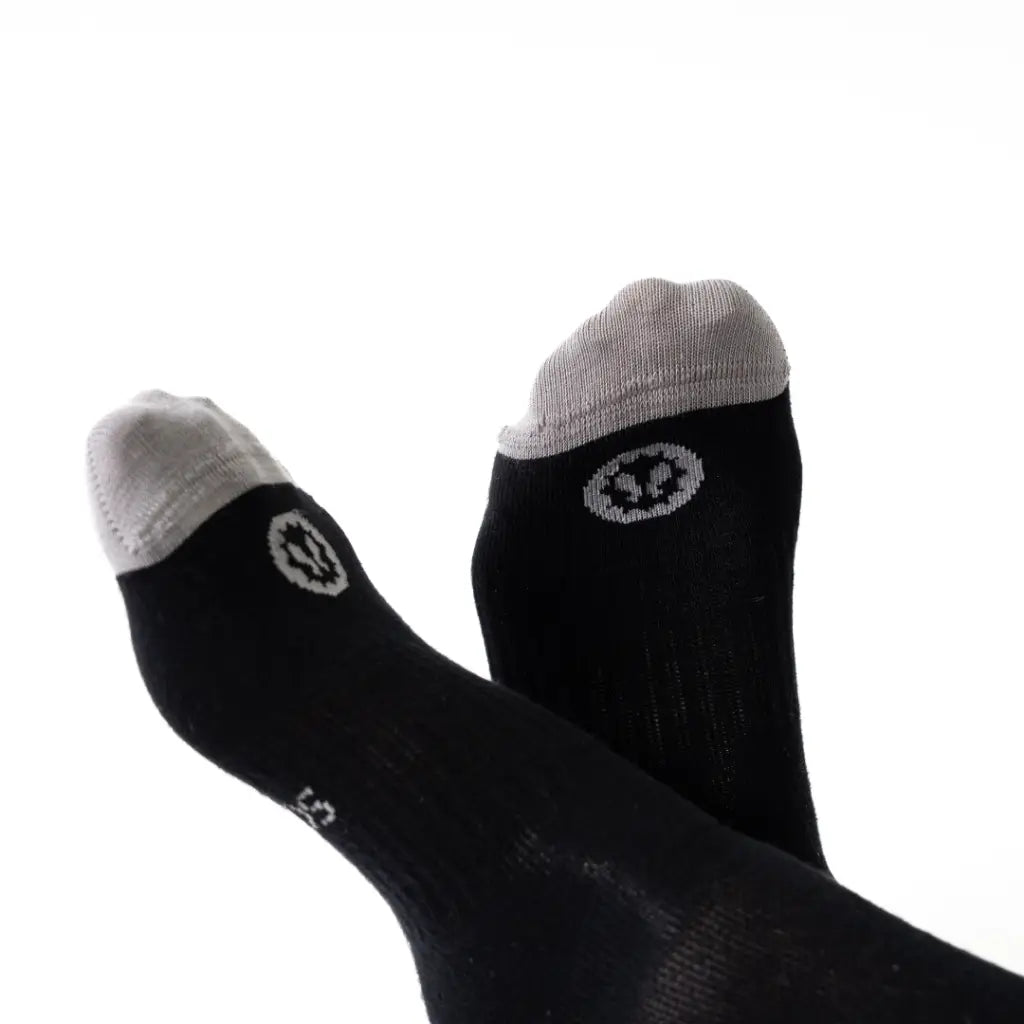
🌿 Nature Bamboo: light compression for sensitive skin
Soft, breathable bamboo viscose, with light graduated compression of 14 to 17 mmHg tested in an external laboratory. For everyday use, for cycling, and for skin that complains with other fabrics.
- Firmer at the ankle, easing off towards the knee
- No tight elastic band at the top and no raised seams
- OEKO-TEX Standard 100 certified and made in Spain
Light graduated compression to support everyday well-being. Not a medical device and not available on prescription.
Frequently asked questions about Basoas and Calcetinos
What is Basoas?
A compression sock brand that sells online. As of November 3, 2026, it has three models on its website: a knee-high one with 20-30 mmHg stated, a bamboo one with 15-20 mmHg, and a short one with 12-14 mmHg.
What are bamboo compression socks like?
Bamboo fiber is soft and more breathable than cotton, so it suits sensitive skin and people whose legs sweat a lot. If you are reading reviews of a specific model, check whether the reviewer says what size they chose and how many hours they wear them: that will tell you the most about how they will work for you.
Is 20-30 mmHg compression better than 14-17?
It depends on what you want it for. 14-17 is light compression for everyday well-being. 20-30 already falls within the pressure levels that a doctor usually sets when prescribing compression stockings. If no one has prescribed a specific compression for you and what you want is everyday well-being, the light range is designed for that. When in doubt, ask your doctor.
What compression sock size is right for me?
The one your leg calls for, not your foot. What matters is the calf circumference, which is where the sock distributes the pressure; the foot stays loose whichever size you choose. Get a tape measure and check our size guide before ordering.
Where can I see Calcetinos reviews?
On our reviews page, with all the verified purchase reviews for each model.
Note: informational content, it does not replace the assessment of a healthcare professional. The Basoas data comes from its public website and is quoted as it appeared on the date indicated.
So, Basoas or Calcetinos?
If your doctor has prescribed strong compression, that is the one you need. If what you are looking for is light compression to end the day with less tired legs, choose by material and by size, and look carefully at what each product page states before paying. You can find all of ours in our compression socks.
Remember that not all compression socks are Calcetinos... nor are they all the same 😉
Sources
- Basoas. Catalog, product pages, and refund policy published on basoas.com, consulted on November 3, 2026.
- Calcetinos. Product pages, size guide, shipping policy, and refund policy published on calcetinos.com, consulted on November 3, 2026.
- Michigan Medicine, Orthotics & Prosthetics Center. Gradient Compression Stockings (patient education material). States that the doctor's prescription determines the length and compression strength of the stocking, with strengths of 20-30, 30-40, and 40-50 mmHg. Available at: med.umich.edu