mmHg stands for millimeters of mercury, and in compression stockings, it indicates how much pressure the fabric exerts on your leg. The higher the number, the tighter the compression. Typical ranges go from less than 15 mmHg, which is light support for daily well-being and can be purchased over-the-counter, to over 40 mmHg, a strong compression always used under the guidance of a healthcare professional. Between these extremes, there are other ranges that are easily confused.
And with good reason. You’re looking at a box, or an online store’s product page, and you see “15-20 mmHg,” “Class I,” “22-29”: numbers that mean nothing if no one has explained the scale to you before. Let’s clarify it.
What is mmHg and why is it measured like blood pressure?
Millimeter of mercury is a unit of pressure. It’s exactly the same unit your doctor uses to measure your blood pressure, and that’s where much of the confusion comes from: if you search for “mmHg” alone, what you get is blood pressure. In a compression sock, mmHg measures something different: the pressure the fabric exerts inward, on your leg.
Think of it like a hand cupping your calf. It can rest with almost no force, it can hold firmly, or it can really squeeze. mmHg is the way to put a number to that squeeze.
Did you know…? That same pressure isn't felt the same throughout the day. In the morning, with a rested leg, you barely notice it. In the afternoon, with some accumulated swelling, the same sock feels much more present, even though the number is the same: what has changed is your leg.
How many mmHg should a compression stocking have?
The question should rather be how many should the stocking YOU need have, and that depends on what's happening with your legs.
Here's the scale, from least to most:
| Range | What it's called | What it's used for |
|---|---|---|
| Less than 15 mmHg | Light support, well-being | Everyday fatigue, heavy legs in the afternoon, many hours standing or sitting |
| 15-20 mmHg | Light compression | Fatigue, long journeys, feeling of mild swelling, also daily use. |
| 18-21 mmHg | Class I | First step of therapeutic compression1 |
| 22-29 mmHg | Class II, or normal compression | Always with professional indication2 |
| 30-40 mmHg | Class III, or strong compression | Always with professional indication2 |
| More than 40 mmHg | Class IV, or very strong | Always with professional indication2 |
Below 20 mmHg: the everyday range
This is the zone of everyday well-being. Here you'll find socks that you wear on any given Tuesday because you work standing for many hours, because you spend eight consecutive hours sitting in front of a computer, or because you have a fourteen-hour flight ahead of you. No prescription or prior visit is needed, and when you put them on you notice they hold without constricting.
If your starting point is "I get home and my legs feel heavy," this is your range.
It's also your range if you don't feel anything special yet and what you want is to take care of your legs before that end-of-day heaviness appears.
You'll find what that light compression does in each case in what compression socks do.
20 to 30 mmHg: where the professional territory begins
From this point on, compression ceases to be a well-being support and becomes a clinical tool. It is used in specific contexts evaluated by a healthcare professional, with follow-up and with the size measured in consultation.
Tighter doesn't mean better: too much compression, poorly chosen or poorly applied, can be counterproductive. That's why this range is decided in the pharmacy, orthopedics, or clinic, and not by reading a blog (not even this one 😉). Although, for the record, this blog is endorsed by Dr. Erica Homs, an expert in compression.
30 to 40 mmHg and above
Strong and very strong compression. Reserved for quite specific situations and always under medical supervision. If you’ve come this far looking for “strong compression stockings 30-40 mmHg” because you were recommended them, what you need is to speak with whoever recommended them before comparing products on your own.
Why are 15-20 and Class I not the same?
It turns out that two different scales coexist in the same market. The European one, which groups compression into classes (I, II, III, and IV) and comes from technical standards such as the German RAL-GZ 387 and the European ENV 127181. And the Anglo-Saxon one, which skips classes and labels directly with the range in millimeters: 8-15, 15-20, 20-30, 30-40.
Since the two systems measure with different methods and tolerances, the ranges overlap but don't quite match3. A product labeled "20-30 mmHg" in the American style and another labeled "Class I" in the European style can end up applying similar pressure without having the same number on the box. That's why comparing isolated figures between brands is a bad sport: what's useful is to look at the general category (light, normal, strong) and, above all, whether the manufacturer states where that number comes from.

And how many mmHg do Calcetinos have?
14 to 17 mmHg, tested in an external laboratory.
Notice that this number does not match any commercial category. It falls just below the first therapeutic step, in the light support zone, without quite fitting into “15-20” or “Class I.” And it’s there on purpose.
We could round up and say 15-20, which is a range that sounds more familiar. We prefer to give you the number the laboratory device measured, even if it doesn’t fall into any round category.
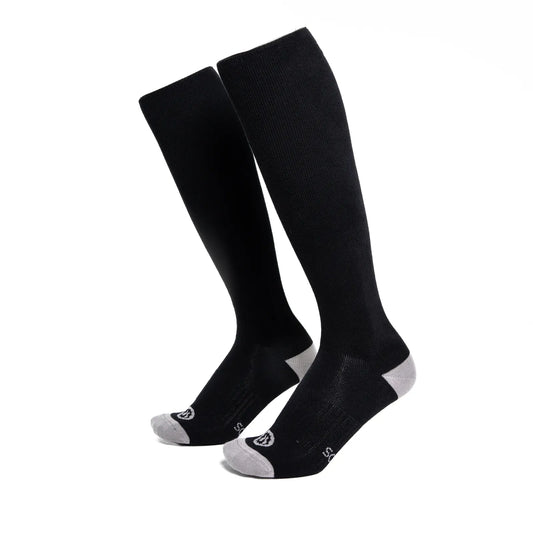
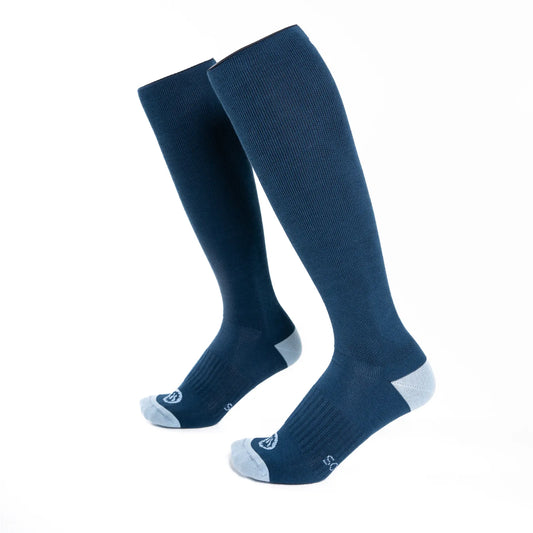
Calcetinos are everyday wellness socks with light gradual compression. To get home with less tired legs after a shift on your feet, eight hours in a chair, or a long flight. They are not a medical device and are not available on prescription.

🧦 Calcetinos: the number the laboratory measures
Light gradual compression of 14-17 mmHg verified in an external laboratory, in four materials depending on what you do every day. Made in Spain and OEKO-TEX Standard 100 certified.
- Compression tested in an external laboratory
- More pressure at the ankle and less towards the knee
- No tight elastic band at the top and no raised seams
Daily wellness product. If you have persistent discomfort, consult a professional first.
The number only tells half the story
A sock can claim 15 mmHg and apply it in a completely useless way. Because for compression to work, both how much it squeezes and where it squeezes most are important.
The pressure needs to be greater at the ankle and gradually decrease towards the knee. That is gradual compression, and it's what assists blood on its journey back to the heart, which goes uphill and against gravity. If the pressure is uniform, or worse, if it squeezes more above than below, the effect is lost.
Two points to be clear about here:
- Compression is for the leg, not the foot. There is no compression on the foot at any time: the fabric fits comfortably, no matter what foot size you have or what size you choose. All the work happens between the ankle and the knee.
- Size is chosen by measuring the leg. If you only look at your shoe size, it's easy to get it wrong. What determines if gradual compression will work on your leg is the circumference of your calf, so it's worth checking the size guide before ordering.
How to know if compression stockings are good?
Since you're looking at numbers, here are the signals that distinguish one from another:
- The number is specific. A manufacturer who has measured will tell you 14-17, or 18-21. If the label only says "medium compression", with no figure, you don't know how much it squeezes.
- Someone external has checked it. That the compression is tested in an external laboratory is the difference between a fact and a promise.
- The compression is gradual. More at the ankle, less at the top. If the brand doesn't mention it, be suspicious.
- They don't have a tight elastic band at the top. For Calcetinos, this is a deliberate decision: an elastic that constricts your leg goes against everything else. That's why sometimes the top part feels a bit loose, and that's okay.
- They don't have patterns or raised seams. They look very cute in photos but they constrict at specific points, ruining the progression of the pressure. We prefer elegant design and intact compression.
- You know what they are made of and where. OEKO-TEX Standard 100 certification and manufacturing in Spain, in our case, and in other cases, you'll have to ask.
When you see a number on a box, ask yourself who measured it.
And if, after reading all this, all you want is to simply get home and feel your legs less heavy, don't panic: that's what 14-17 mmHg are for, and for that, you don't need to learn any scale.
Remember that not all compression socks are Calcetinos… nor are they all the same 😉

Sources
- Vascular Nursing Journal. Review of recommendations for compression therapy. Cites RAL-GZ 387 (Germany) and ENV 12718 (European Committee for Standardization) as classification references, and details the indications for each class according to the CEAP scale. Link
- Farmalastic (Cinfa Laboratories). Differences between compression and rest stockings. Establishes the ranges of the scale commonly used in Spain: light 18-21 mmHg, normal 22-29 mmHg, strong 30-40 mmHg, and very strong above 40 mmHg. Link
- OrthoMed. Compression Sock Ratings: mmHg vs Class Systems (US, Canada & Europe). Explains that European classes and Anglo-Saxon mmHg ranges overlap but are not equivalent, because standards differ in measurement methods and tolerances. Link