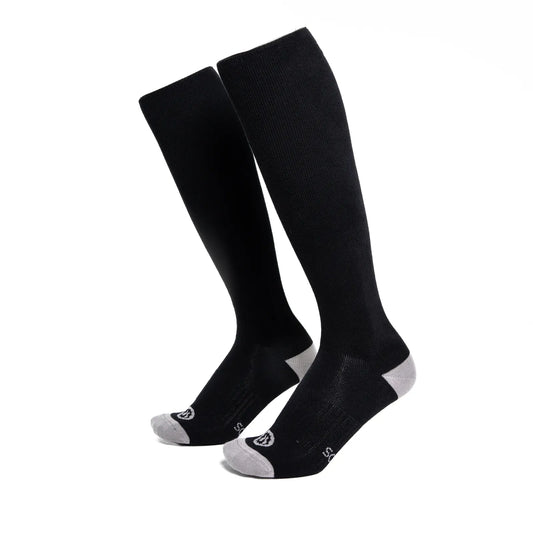
Compression socks help blood travel back from the ankles toward the heart, which relieves heaviness, fatigue, and swelling in the legs.
If you think of your grandmother’s stockings or a footballer’s leg sleeves when you hear “compression socks,” this short answer only tells half the story. There is medical compression and light compression, there are uses where the evidence is solid and others where too much has been promised, and there are very young profiles who could benefit and never even consider it. Let’s go step by step, starting with what a compression sock does inside your leg.
How do compression socks work?
Your blood flows down to your feet effortlessly because it’s going downhill. The problem is the return trip: it has to climb back up to the heart, against its own weight. To manage this, the leg has two helpers. The first is the calf, which contracts with every step and squeezes the veins inside it, like wringing out a cloth. The second are valves inside the veins that act as doors: they open upward and close so the blood doesn’t fall back down.
When you spend hours standing still, or sitting, your calf barely works and the blood pools in the lower part of the leg. Think of a river: where the channel widens, the water slows down, and where it narrows, it flows faster. A compression sock gently squeezes the leg from the outside, narrows that channel slightly, and the blood circulates more freely. A 2023 meta-analysis that brought together 22 studies with healthy people found that sports compression garments increase blood flow through the veins at rest, during exercise, and in recovery1.
The key is how that squeeze is distributed. In a graduated compression sock, the pressure is highest at the ankle and decreases toward the knee, so the push goes in the direction the blood needs to go: upward. If you want the details, we cover them in how graduated compression works.
What are they for? Benefits of compression socks
With that mechanism in mind, the uses explain themselves. These are the main ones.
Tired, heavy, or swollen legs
Let’s start with the most obvious one. That feeling of getting home with legs that seem to weigh twice as much, ankles a little thicker than in the morning, or the mark of your regular socks clearly printed on your skin… All of that has a lot to do with the blood and fluid that build up in the lower leg over the day, and compression helps less of it build up. If swelling is your case, our post on swollen legs reviews the most frequent causes.
Long hours standing or sitting
Here the evidence is quite clear, and it was gathered with light compression. In a study published in Dermatologic Surgery, twelve volunteers wore socks of different pressures on one leg only for several days, to compare it with the other, and their leg volume was measured in the morning and seven hours later. The authors concluded that knee-high socks with a pressure between 11 and 21 mmHg reduce or completely prevent evening swelling, and that they can be recommended to anyone who works long hours standing or sitting2.
Another trial, with 108 hairdressers, compared their working days with and without low-strength compression stockings (15-20 mmHg). With the stockings on, they felt less pain and less swelling, and their leg volume went down3.
We have a page for each case: compression socks for standing all day and compression socks for sitting all day.
Long journeys
On a plane, a night bus, or a car ride to the beach, your legs spend hours bent and barely moving, which is why it’s common to arrive with swollen feet. Graduated compression is a good travel companion for arriving with lighter legs. We explain everything on our page about compression socks for flying.
Pregnancy
During pregnancy it’s common for feet and legs to swell, especially in the last months, and in our post on swollen feet during pregnancy we explain why it happens. Light compression can make those days easier, always after checking with your midwife or gynecologist first. You’ll find more information on compression socks for pregnancy.
Varicose veins
Two things need to be kept apart here. When there are already varicose veins or venous insufficiency (the vein valves don’t close properly and blood tends to stay in the lower leg), compression is part of the treatment, but that is medical compression: it is prescribed by a professional, squeezes considerably more, and is bought at a pharmacy. Light compression stays outside that treatment: its place is to support the daily routine of legs that are starting to show signs of tiredness, as part of good habits, and always with your doctor’s advice if you already have a diagnosis. We go into it calmly on our page about compression socks for varicose veins.
Are they only for older people? Preventive use and young people
The idea that compression is for older people doesn’t hold up, and the studies above show it quite well. The researchers in the twelve-volunteer study describe evening swelling as a physiological phenomenon, that is, something that happens to a healthy leg after a long time sitting or standing2. You don’t need to be a certain age or have a medical condition: a job or a routine that keeps you still is enough.
And that includes very young profiles: someone studying for exams eight hours a day in a chair, someone working from home, the waiter doing back-to-back afternoon and night shifts, the nurse who spends the whole shift standing, or someone taking a twelve-hour flight to go on holiday.
Wearing light compression in those cases works like sunscreen: you don’t wait until you’re burnt to put it on. Its job is to help you reach the end of the day with less tired legs, and that feels just as good at 25 as at 60. Preventing disease is your doctor’s territory.

Are compression socks useful for sport? What the evidence says
In sport, compression lives between two exaggerations: the one that sells it to you as if you were going to beat your time in the next race, and the one that says it’s useless. Meta-analyses (studies that pool the results of many earlier studies to reach a more solid conclusion) paint a picture that is far more interesting than either extreme.
Recovery and heavy legs: here there is support
This is where the evidence is most favorable:
- Less muscle soreness and better muscle recovery. A meta-analysis published in the British Journal of Sports Medicine found that compression garments have a moderate effect on reducing delayed onset muscle soreness and on recovering strength and power faster after exercise that damages the muscle4.
- Above all, recovering strength. A later, broader meta-analysis found that the clearest benefit is in strength recovery, especially after weight training and once 24 hours have passed5.
- Less muscle swelling and better perceived recovery. Another meta-analysis, with the participation of Spanish researchers, found less muscle swelling and better sensations when using compression for recovery, although the authors themselves call for more studies to confirm it6.
- Less perceived pain. A 2022 review concludes that compression may reduce the sensation of muscle pain after exercise, and that it is unlikely to do any harm7.
Performance: little or none
Here things change:
- A meta-analysis on high-intensity exercise found no improvements in running performance, jumping, or oxygen uptake when wearing compression on the legs8.
- A review focused on runners speaks, at most, of slight improvements in some endurance variables, and of clearer benefits for pain and muscle damage afterwards9.
- And not all studies agree: a 2022 meta-analysis did not find that wearing compression during or after training helped recover strength10.
In short: compression makes more sense for recovering and keeping your legs from feeling so heavy than for going faster. And an honest warning: those studies used very different sports garments, with varied pressures and designs, so their results can’t be transferred as they are to any specific sock, ours included.

What about calf sleeves?
Calf sleeves are a tube of elastic fabric that covers only the calf and leaves the foot and ankle free. You’ll see them at running races and in recovery. The difference from a graduated compression sock lies precisely in what they leave out: the ankle, which is where graduated compression squeezes most and where the upward push begins. We explain why it matters so much where a garment squeezes in how graduated compression works.
If you do sport and are interested in compression for your training, you’ll find all the models designed for it in our sports compression socks collection.
Who shouldn’t wear them without checking first?
Used properly, compression rarely causes serious problems, but there are cases where a professional should give the go-ahead first. An international consensus of compression specialists lists the following contraindications, among others11:
- Severe peripheral arterial disease. When blood already has trouble reaching the foot through the arteries, squeezing the leg can make that blood supply worse.
- Severe heart failure. Here the decision always belongs to the cardiologist.
- Diabetes with loss of sensation in the legs. If you can’t feel your leg well, you may not notice that something is squeezing too much.
- Confirmed allergy to the sock material.
If any of these applies to you, or you have any doubts about your circulation, talk to your doctor first. And if a sock bothers you or hurts while you’re wearing it, take it off and get it checked.
Light compression or medical compression?
Not all compression socks squeeze the same, and the difference changes what they are for. Medical compression squeezes more, is indicated by a professional to treat a specific venous problem, and is bought at a pharmacy. Light compression is designed for everyday well-being: tired legs, long hours standing or sitting, travel, and as a preventive habit.
Pressure is measured in mmHg (millimeters of mercury), and understanding that number is the best way to know what you’re buying. We explain all the classes in what mmHg means in compression stockings, and if you’re not sure where to buy them, pharmacy or online? covers the differences.
Which compression socks should you choose for everyday use?
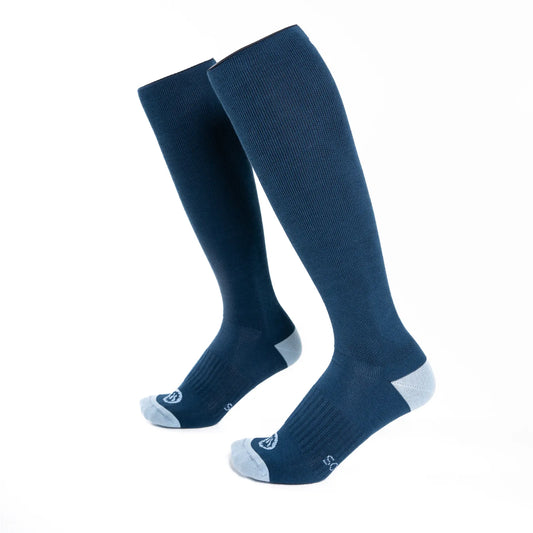
Calcetinos have light graduated compression of 14 to 17 mmHg, tested by an external laboratory: firmer at the ankle and easing off toward the knee. That range falls within the one that showed good results against evening swelling in the twelve-volunteer study2. They are made in Spain and certified OEKO-TEX Standard 100. To be completely clear: they are not a medical device, they are not available on prescription, and they don’t replace professional advice if you have a circulation problem.
They all compress the same, so the choice comes down to the material and how you’ll use them:
Choose your Calcetinos to suit your day
All with light graduated compression, up to just below the knee. The material changes, the compression doesn’t.


Light graduated compression of 14 to 17 mmHg, made in Spain. Not a medical device.
One last detail that makes a difference: size is chosen by your calf measurement, not your shoe size. The leg is what receives the compression, and the foot of a pair of Calcetinos stays loose, without squeezing, whichever size you choose. The measurements are in the size guide.
Frequently asked questions
How many hours a day can you wear compression socks?
With light compression, the usual approach is to put them on in the morning, when the leg is least swollen, and take them off at the end of the day. We explain it in detail in how long should you wear compression socks.
Can you sleep in compression socks?
There’s no need, unless a doctor has told you to. Lying down, your leg is at the same height as your heart and the blood no longer has to climb uphill, so the compression has no work left to do. We go into it in should you wear compression socks to sleep?.
Are compression stockings and compression socks the same thing?
They work the same way: what changes is how far up they go. Socks usually refers to the ones that reach just below the knee, like Calcetinos, and stockings to the ones that go up to the thigh or waist. For everyday discomfort, the area that matters most is from the ankle to the knee.
Do I need a prescription to buy compression socks?
For light compression, no. Medical compression is indicated by a professional and bought at a pharmacy. You’ll find the differences in pharmacy or online? Where to buy compression stockings.
Do compression socks improve sports performance?
According to the available meta-analyses, little or not at all. Where they have the most support is in recovery: less muscle soreness and faster strength recovery after an intense effort.
Note: this content is for information only and does not replace the assessment of a healthcare professional.
So, who should try them?
Anyone who ends the day with heavy legs, spends long hours standing or sitting, travels often, or wants to recover better after training, whatever their age. And if you have a diagnosed circulation problem, the person who decides what compression you need is your doctor.
If you want to see all the models together, here they are:
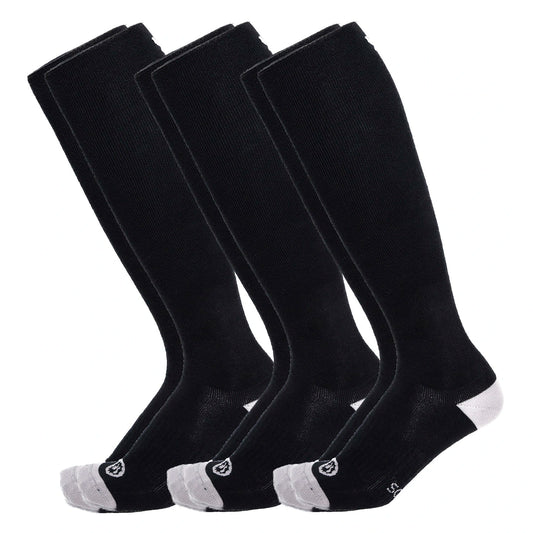
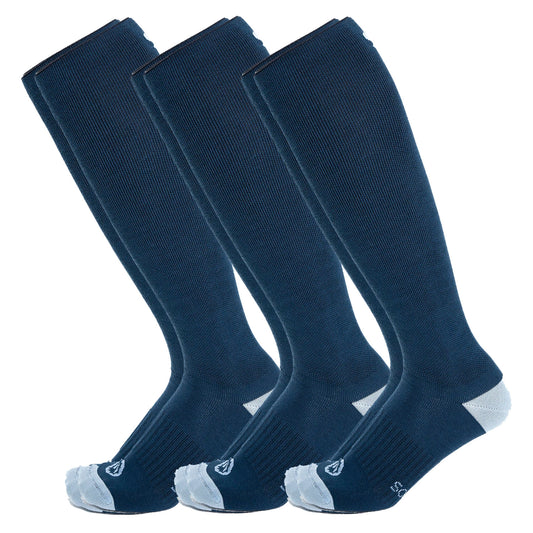
And if there are several of you at home with tired legs, a pack works out better:
They’re not just for older people and they won’t turn you into an Olympic athlete, but your legs will notice. Remember that not all compression socks are Calcetinos… or the same 😉
Sources
- O’Riordan SF, Bishop DJ, Halson SL, Broatch JR. Do Sports Compression Garments Alter Measures of Peripheral Blood Flow? A Systematic Review with Meta-Analysis. Sports Medicine. 2023;53(2):481-501. Available at: pubmed.ncbi.nlm.nih.gov/36622554
- Partsch H, Winiger J, Lun B. Compression stockings reduce occupational leg swelling. Dermatologic Surgery. 2004;30(5):737-743. Available at: pubmed.ncbi.nlm.nih.gov/15099316
- Blazek C, Amsler F, Blaettler W, Keo HH, Baumgartner I, Willenberg T. Compression hosiery for occupational leg symptoms and leg volume: a randomized crossover trial in a cohort of hairdressers. Phlebology. 2013;28(5):239-247. Available at: pubmed.ncbi.nlm.nih.gov/22451457
- Hill J, Howatson G, van Someren K, Leeder J, Pedlar C. Compression garments and recovery from exercise-induced muscle damage: a meta-analysis. British Journal of Sports Medicine. 2014;48(18):1340-1346. Available at: pubmed.ncbi.nlm.nih.gov/23757486
- Brown F, Gissane C, Howatson G, van Someren K, Pedlar C, Hill J. Compression Garments and Recovery from Exercise: A Meta-Analysis. Sports Medicine. 2017;47(11):2245-2267. Available at: pubmed.ncbi.nlm.nih.gov/28434152
- Marqués-Jiménez D, Calleja-González J, Arratibel I, Delextrat A, Terrados N. Are compression garments effective for the recovery of exercise-induced muscle damage? A systematic review with meta-analysis. Physiology & Behavior. 2016;153:133-148. Available at: pubmed.ncbi.nlm.nih.gov/26522739
- Weakley J, Broatch J, O’Riordan S, Morrison M, Maniar N, Halson SL. Putting the Squeeze on Compression Garments: Current Evidence and Recommendations for Future Research: A Systematic Scoping Review. Sports Medicine. 2022;52(5):1141-1160. Available at: pubmed.ncbi.nlm.nih.gov/34870801
- da Silva CA, Helal L, da Silva RP, Belli KC, Umpierre D, Stein R. Association of Lower Limb Compression Garments During High-Intensity Exercise with Performance and Physiological Responses: A Systematic Review and Meta-analysis. Sports Medicine. 2018;48(8):1859-1873. Available at: pubmed.ncbi.nlm.nih.gov/29721839
- Engel FA, Holmberg HC, Sperlich B. Is There Evidence that Runners can Benefit from Wearing Compression Clothing? Sports Medicine. 2016;46(12):1939-1952. Available at: pubmed.ncbi.nlm.nih.gov/27106555
- Négyesi J, Hortobágyi T, Hill J, Granacher U, Nagatomi R. Can Compression Garments Reduce the Deleterious Effects of Physical Exercise on Muscle Strength? A Systematic Review and Meta-Analyses. Sports Medicine. 2022;52(9):2159-2175. Available at: pubmed.ncbi.nlm.nih.gov/35476183
- Rabe E, Partsch H, Morrison N, Meissner MH, et al. Risks and contraindications of medical compression treatment: A critical reappraisal. An international consensus statement. Phlebology. 2020;35(7):447-460. Available at: pmc.ncbi.nlm.nih.gov/articles/PMC7383414