You take off your sock and there it is, right below the knee: a red line, sometimes a groove. It's left by the sock's elastic or cuff, a narrow band that carries all the hold and squeezes the leg in a single spot.
A Calcetino doesn't have that band. It stays up thanks to the compression fabric itself, spread along the whole leg, and that's also where the patterns come in: socks that don't squeeze in a single spot need plain fabric exactly where they compress.
Let's take it step by step, because the groove, the compression and the patterns are really the same story.
Why do my socks squeeze?
A sock has to grip somewhere so it doesn't end up bunched around your ankle. In an ordinary sock, the elastic at the top does that job. In compression socks, the usual construction is a double cuff: 2 or 3 centimeters of fabric folded over itself which, being doubled, pulls twice as hard in that same narrow band. Either way, everything that holds the sock up is concentrated in a few centimeters.
Think of a grocery bag packed to the top. If you carry it by a thin handle, it digs into your fingers and leaves a mark; with the same weight in a bag with a wide handle, you barely notice it. The weight is the same: what changes is the surface it's spread over.
Why does the mark appear right below the knee?
Something similar to the bag happens with your leg, plus one more detail. Fabric wrapped around the leg squeezes according to how tight it is and how narrow that part of the leg is: with the same tension, it squeezes harder where the leg is slimmer, because the curve is tighter, and at points where bone or tendon sits close to the skin, with no soft tissue underneath to spread the pressure1. Just below the knee, on the outer side, is the head of the fibula, one of the spots the international consensus on medical compression flags as an area of higher local pressure1. That's roughly where a knee-high sock ends.
Add it all up and you get a narrow band, with double fabric pulling, sitting on an area of the leg that already takes more pressure. The groove you find at night is the result of hours of that band doing its job.
And there's one last ingredient: after many hours on your feet, or sitting through a long trip, it's common for your feet and ankles to swell a little2. The same elastic you didn't even notice in the morning digs in harder by the evening.

Is it normal for socks to leave a mark?
If you've looked it up, you'll have read both things: that it's normal if it fades within a few minutes, and the opposite, that a sock mark isn't normal. Both are partly right, because they're talking about different marks.
- A faint line that fades after a while. It's the imprint of the fabric on your skin. The international consensus on medical compression describes it: when you take off a well-fitting garment, red lines can be left around the leg, especially where the leg bends as you move and the fabric rubs against the skin, and it describes them as reversible, without counting them among complications1. It happens with a Calcetino and with any sock that fits snugly on the leg.
- A deep groove that stays for a good while. This mark is left by a band that squeezes too hard in a single spot, like a tourniquet, and the same consensus recommends avoiding exactly that: a garment acting as a tourniquet on the leg1. When the groove is deep, the first thing to check is the size, and then the top edge: a tight elastic or a double cuff concentrates the hold in very little space.
A line is no reason for alarm. What is worth mentioning to your doctor or nurse is a mark that comes with something else: new swelling or swelling that gets worse in one leg only, a leg that is red and warm to the touch, or swelling that doesn't improve with rest or with your legs up2.
"A faint line that disappears shortly after taking off the sock is the imprint of the fabric on the skin and nothing more. What is worth keeping an eye on is a deep groove that is still there long afterwards, or a mark that comes with a swollen ankle and doesn't improve with rest. That usually means the garment is squeezing too hard in one spot or the size isn't right, and if it keeps happening, it's worth seeing a professional."
Dr. Erica Homs Romero, nurse specialising in vascular health and lecturer in Nursing at the University of Girona
Why doesn't a Calcetino squeeze the same way?
If the groove comes from a band carrying all the hold, the way to avoid it is to take that job away from the band.
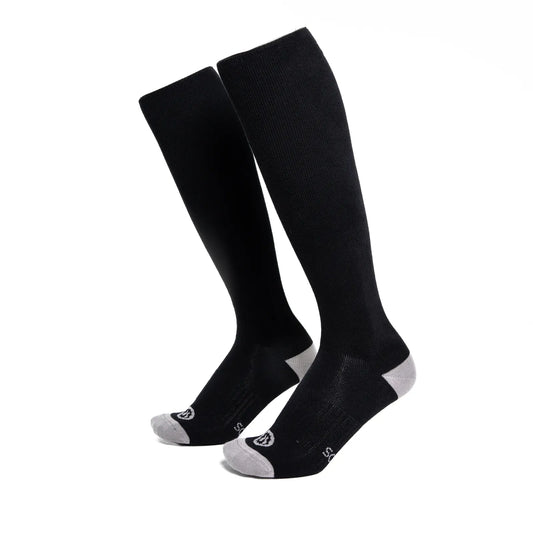
A Calcetino stays up thanks to the compression fabric itself. The pressure is spread along the whole leg, firmer at the ankle and easing off towards the knee, and at the top there's only a minimal finish that completes the sock. There's no elastic holding the sock up and no double cuff, so there's no band left that could act as a tourniquet.
It's the logic of a toothpaste tube: you squeeze from the bottom so the contents move up. With graduated compression, it's easier for blood to make its way back up. And that gradient, more pressure at the bottom and less at the top, comes from the fabric itself, which gradually opens up as it rises along the leg3. If you want the details, we explain how graduated compression works.
Our Calcetinos offer light graduated compression of 14 to 17 mmHg, laboratory tested. If those numbers mean nothing to you, we break them down in what mmHg means in compression socks. They're everyday socks: they are not a medical device and they are not available on prescription.
One practical consequence: you may find the top a little looser than on other compression socks, and it may slip down a bit at times. Its job is to finish the sock, while the hold comes from the fabric along the leg, which is what hugs your calf.
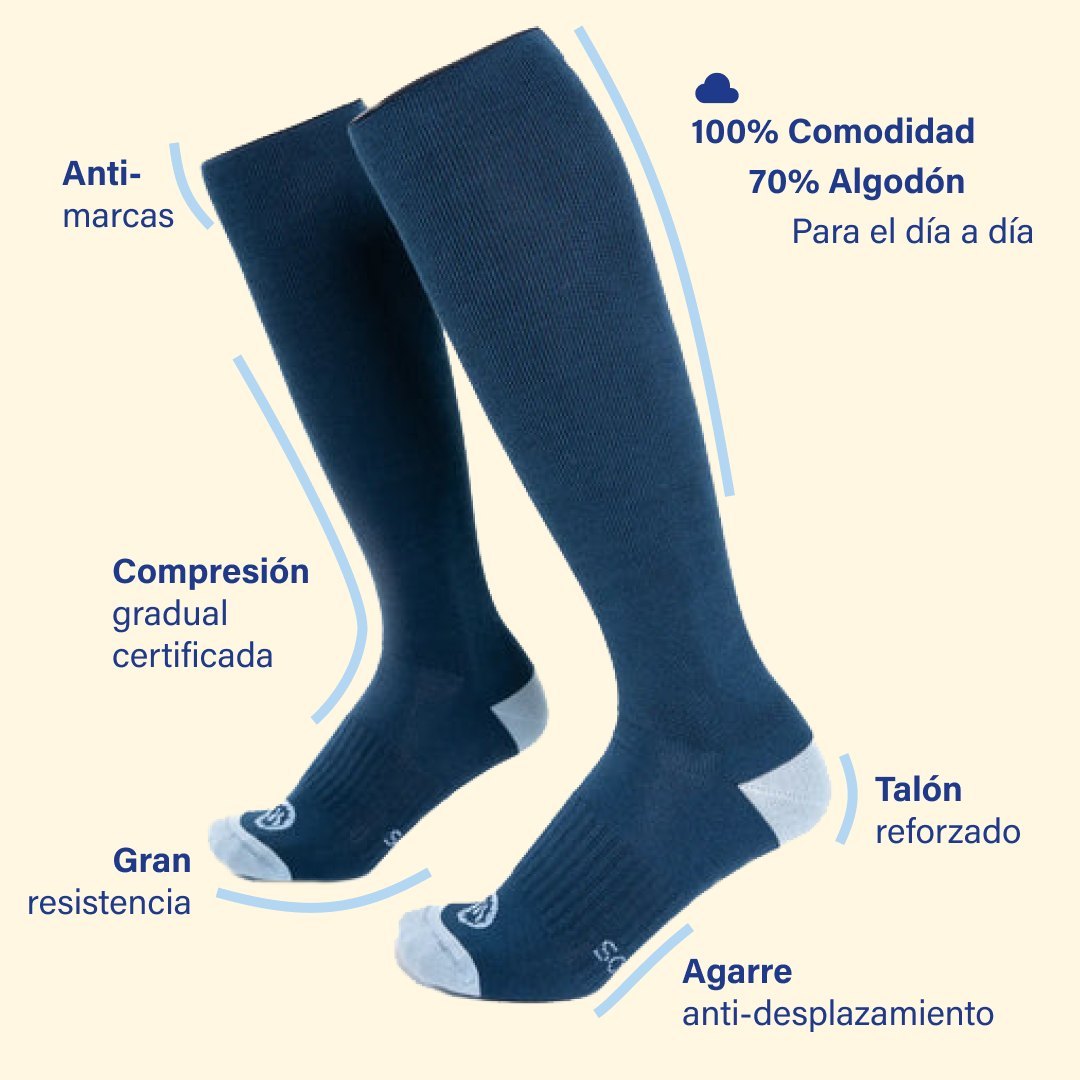
🧦 Basic: plain from top to bottom, for every day
Light graduated compression of 14 to 17 mmHg, laboratory tested, in combed cotton. The hold comes from the fabric itself, so there's no tight elastic or double cuff at the top.
- Firmer at the ankle, easing off towards the knee
- Plain leg with no raised patterns, and flat seams
- OEKO-TEX Standard 100 certified
Light graduated compression to support everyday well-being. They are not a medical device and are not available on prescription.
And this is where the patterns come in
Your fun patterned socks are perfect for what they are: brightening up a Monday, peeking out from under your pants, being the easy birthday gift... They're just not doing this particular job, and the reason lies in how a pattern is knitted.
A sock is a mesh of stitches. To make a pattern appear, the machine keeps changing which yarn forms each stitch: the color that's needed is knitted on the outside, and the one that isn't passes behind, on the inner face, in loose stretches that skip from one stitch to another. Those stretches are called floats4.
In a compression sock, that has two consequences:
- It changes the fabric exactly where the pattern is. And in a compression garment, the way the stitch is knitted is what decides how much it squeezes. A study on graduated compression stockings confirmed it: just by changing how the elastic yarn was inserted into the knit, the pressure the stocking applied changed3. If you add a pattern to the leg of the sock, the fabric in that area is no longer the one that was designed, and the pressure curve, more at the ankle and less at the top, is no longer under control.
- It leaves a raised texture on the inside. Floats sit on the inner face, right against the skin, and they snag easily4. On a leg that spends the day with taut fabric over it, and is a little more swollen by the evening, every raised bit on the inside is one more point of friction. If you're curious about what friction does to the skin over hours, we cover it in our post on blisters when walking.
That's why the leg of a Calcetino is plain from top to bottom: every centimeter of fabric is there to provide the pressure that section of the leg needs.
The same goes for the seams. A Calcetino's seams are flat, with no ridges or excess fabric on the inside, because an inner ridge is one more raised bit, and in an area where the fabric is already taut against the skin.
So why do Calcetinos come in two colors?
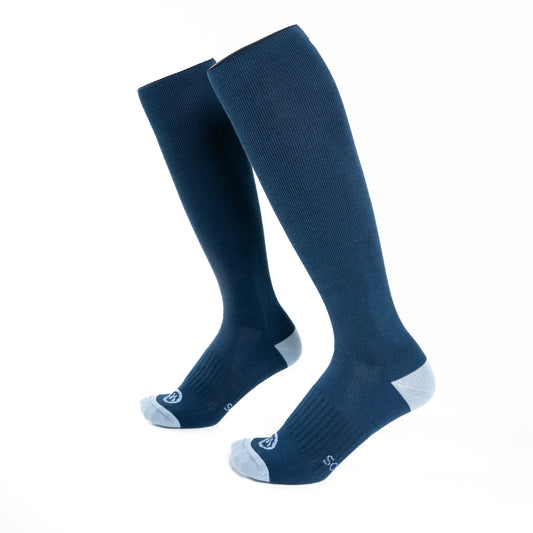
Open the catalog and you'll see a white and fuchsia Basic, a blue-green one with gray, or a gray and beige one. The trick is where the second color goes: on the heel and the toe, in other words, on the foot. And the foot of a Calcetino is loose, with no compression, whatever size you choose.
A change of color on the foot, which doesn't compress, doesn't affect the pressure along the leg. A raised pattern on the leg does. The rule, in one line: no raised patterns or changes to the fabric where the sock compresses. Color goes where it doesn't get in the way.

What to look for when buying socks that don't squeeze?
With all this in mind, you now know where to look (and where to run your finger) before you buy:
- The top edge. Pinch it or turn the sock inside out: if you feel 2 or 3 centimeters of fabric folded over itself, it's a double cuff, and that band will carry the hold. A thin edge with no fold is a sign that the rest of the fabric is doing the holding.
- Run your finger along the inside. Feel for ridged seams, loose yarns behind a pattern or areas thicker than the rest. Whatever you notice with your fingertip, your leg will notice for hours.
- Size by the leg. For a compression sock, you choose the size by measuring the widest part of your calf, which is where the pressure is spread. Your foot size barely matters, because the foot doesn't compress. You'll find how to measure yourself in the size guide.
- The material. Combed cotton for everyday wear and, if you have sensitive or atopic skin, Nature Bamboo, the softest of the family. We explain why in socks for sensitive skin.
And if what you were looking for was socks without elastic, chances are what you really want is to stop getting that groove. There are two ways to get there: remove the elastic and leave the sock loose, or spread the tension across the whole fabric. A Calcetino takes the second route. It has no elastic, but it does have graduated compression along the whole leg, so you'll feel it as firm, especially at the ankle. To put it on without a struggle, you'll find the steps in how to put on compression socks.

Frequently asked questions
Why do my socks squeeze?
Because all the hold of the sock is concentrated in a narrow band: the elastic at the top of an ordinary sock, or a 2 to 3 centimeter double cuff, which is the usual construction in compression socks. With the same tension, that band squeezes harder on slim areas or where bone is close to the skin, like the area just below the knee.
Is it normal for socks to leave a mark?
A faint line that fades after a while, yes: it's the imprint of the fabric on the skin. A deep groove that lasts a long time, no: it means a band is squeezing too hard, usually because of the size or an elastic or double cuff that's too tight.
What happens if I wear tight socks?
The band that squeezes acts as a tourniquet on the leg, which is exactly what compression guidelines say to avoid1. Along the same lines, the tips for leg swelling include not wearing tight clothing or garters around the thighs2. If your legs hurt when you wear tight socks, the first things to check are the size and the top edge of the sock.
Are compression socks supposed to feel tight?
You should feel them, firmer at the ankle and less so towards the knee. What they shouldn't do is hurt, leave a deep groove or make your leg go numb. If any of that happens, the first thing to check is the size.
Why do my compression socks feel too tight?
The most common causes are a size chosen by foot instead of by calf, a double cuff that concentrates the hold at the top, or a sock that isn't put on properly. If the sock rolls or slips down and forms a roll, that roll squeezes in one spot like an elastic1. You'll find how to put them on properly in how to put on compression socks.
How do I loosen socks that are too tight?
There's no reliable fix. When the elastic squeezes, it's because that band is too narrow for your leg, and the solution is a different sock or a different size. With a compression sock, forcing the fabric is also a bad idea, because the pressure it applies depends on how it's knitted.
Are there socks that don't squeeze for both men and women?
Calcetinos are the same for men and women. What changes is the size, which you choose by your calf using the size guide.
Note: this content is for information only and does not replace an assessment by a healthcare professional.
So, do you miss the fun patterns?
The cactus and polka dot ones can stay in the drawer for the days that call for them. For your legs' everyday life, what helps is plain fabric that spreads the pressure along the whole leg and doesn't leave any band acting as a tourniquet. That's why a Calcetino looks the way it does.
If you want to see them all together, here they are:
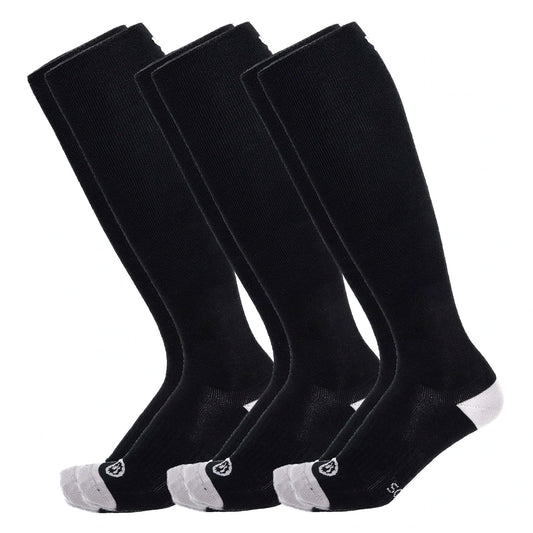
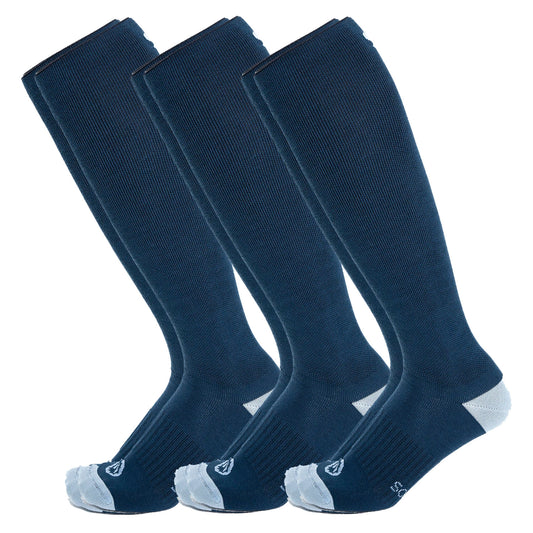
And if there are several of you at home with marked legs by the evening, a pack works out better:
The patterned-sock drawer for the party days, and the Calcetinos drawer for your legs. Remember: not all compression socks are Calcetinos... nor are they all the same 😉
Sources
- Rabe E, Partsch H, Morrison N, Meissner MH, Mosti G, Lattimer CR, et al. Risks and contraindications of medical compression treatment – A critical reappraisal. An international consensus statement. Phlebology. 2020;35(7):447-460. Available at: doi.org/10.1177/0268355520909066
- MedlinePlus, U.S. National Library of Medicine. Foot, leg, and ankle swelling. Review date: May 19, 2025. Available at: medlineplus.gov
- Jamshaid H, Mishra RK, Ahmad N, Nadeem M, Muller M, Kolar V. Exploration of Effects of Graduated Compression Stocking Structures on Performance Properties Using Principal Component Analysis: A Promising Method for Simultaneous Optimization of Properties. Polymers. 2022;14(10):2045. Available at: doi.org/10.3390/polym14102045
- Cotton Incorporated. Designing Knit Textiles. CottonWorks. Available at: cottonworks.com