You’ve been walking for three hours, you take off your boot, and there it is: that hot spot on your heel that will be a blister tomorrow.
To avoid them, there is an order that works, and it starts far from the sock: well-broken-in footwear of your size, a sock that wicks away moisture, and changing your socks halfway through long treks. Everything else comes after. Let’s see why that order is what it is, and what to do if you already have one.
Why do blisters form when walking?
There is a surprise here, and it explains everything else.
For decades, it has been said that a blister is an abrasion: the skin is sanded against the sock until it lifts. More recent research suggests a different mechanism. What happens is that high friction leaves the skin stuck to the sock or the boot, while the bone inside keeps moving with every step. And what breaks isn't on the surface: it’s the intermediate tissue layers, twisted between skin that won't move and a bone that won't stop.1
Think of it like a sandwich. If you hold the top slice with your hand and push the bottom one, the outer bread holds up perfectly. What gets displaced and tears is what's inside. Fluid accumulates there, and that is the blister.
This shift in focus matters much more than it seems because it changes what needs to be done. If the problem were sanding, a smooth surface would suffice. Since the problem is that the skin gets stuck, what you need is for the foot to slide inside the sock and for the sock not to get locked in place. And moisture is the deciding factor there.

Why do wet socks cause the most blisters?
Because damp skin has more grip. Dry skin slides inside a sock; soaked skin sticks to the fiber, and from that point on, every step works against the underlying tissues instead of sliding.
The General Council of Official Podiatry Associations lists friction and moisture among the main risk factors and provides the advice with the best effort-to-result ratio in this entire article: change your socks at least once on long treks to keep your feet dry.2
A clean pair in an outside pocket of your backpack weighs forty grams and saves you half the trouble. If your feet also sweat a lot, the material of the sock ceases to be a detail and becomes the first priority.
How to avoid blisters when walking, in order of effectiveness
This is the order:
- Footwear and sizing. This is the most important, by far. If your foot shifts inside the boot, no sock can fix it.
- The sock. Material, seams, and fit. This is where we can help you.
- Lubrication. Vaseline and creams in areas prone to chafing.
- Dressings. Targeted protection where you know you're prone to getting them.
What to look for in footwear before a long trek?
- Make sure they are broken in. You don’t break in a new boot on a long trek or the Camino. It needs quite a few short kilometers before a long day.
- A finger’s width of margin in the front. On descents, your foot slides forward, and if it hits the toe box, your nails and toes will pay for it.
- Laces, tied securely and checked mid-trek. A loose foot inside the boot is exactly the scenario that produces blisters.
- Size, measured in the afternoon. Feet swell throughout the day and also while walking, so a morning measurement is deceptive.
If your footwear is sorted, then yes, the sock makes the difference.
Which sock helps prevent blisters?
Three things, in this order: how it handles moisture, its seams, and how well it fits.
Material determines moisture management. Technical fibers like Coolmax or polyamide wick sweat outward and dry quickly. Cotton is very comfortable and pleasant, but it absorbs a lot of water and takes a while to release it, so it's not the best choice for a long day in the heat. For the evening, when your feet are resting, it's a different story and it wins there.
Regarding breathability figures, you won't read any here. There are very specific percentages circulating comparing fibers, and we haven't found any serious study that supports them, so we prefer not to invent them.
Seams and ridges cause chafing. Embroidery on the sole or a thick seam at the toes is a pressure point in a spot where you're going to take thirty thousand steps. That is why Calcetinos do not have embossed designs or patterns. It is a deliberate technical decision: those seams press on specific points and ruin the graduated compression.
Fit prevents wrinkles. A sock that slides around creates folds, and a fold chafes just like a seam.

What is an anti-blister sock?
There is no official definition, so it's worth knowing what to look for when you see that word on a label. A sock sold as anti-blister should fulfill three things:
- Manage moisture. Fiber that wicks sweat and dries quickly, because a damp foot is the starting point of the problem.
- Have no seams in chafing areas. Especially on the toes and the heel.
- Not move inside the boot. Reinforced sole covering the entire footbed and a size that provides a snug fit.
A systematic review of eleven studies on blister prevention concluded that there is a scarcity of high-quality evidence supporting socks, antiperspirants, or barriers.3 That doesn't mean they don't work; it means they have been studied little and with disparate methods. We prefer to tell you that rather than sell you a certainty that science does not yet have.
What is clear is how each material reacts with water, and that is where we choose well.

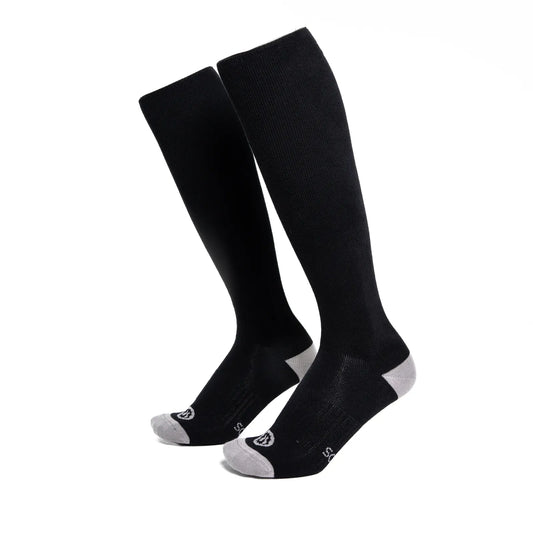
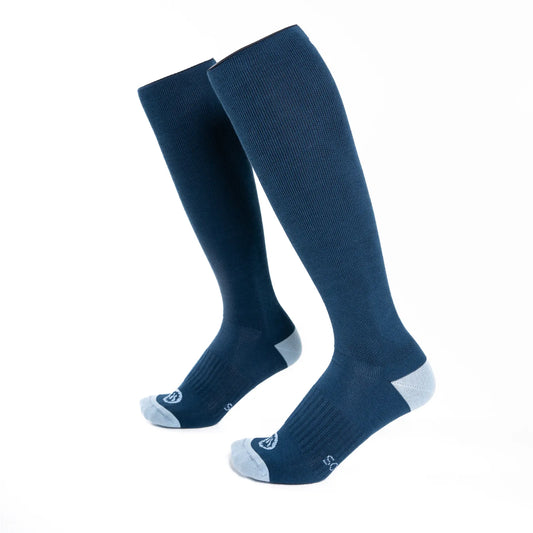
🥾 Dynamic: for long walks
Polyamide that wicks moisture and dries quickly, reinforced sole on the entire footbed, and light graduated compression of 14-17 mmHg verified by an external laboratory. It is the one we recommend for hiking and long treks.
- 100% reinforced sole, the area that works hardest when walking
- No embossed designs, so as not to create pressure points
- OEKO-TEX certified and made in Spain
If you have the Camino ahead of you, there is an entire guide on what material to choose, how many pairs to take, and how to wash them in the hostel: socks for the Camino de Santiago.
Are Vaseline, talcum powder, and double socks effective?
To each their own, but it's worth knowing what each thing does before putting it in your backpack.
Vaseline reduces chafing while it's there. The General Council of Podiatry includes it among its prevention recommendations along with creams.2 Its effect doesn't last all day, so if you use it, plan to reapply it during stops and don't count on it being effective by hour six.
Talcum powder aims for the opposite: to dry rather than lubricate. You have to be careful here, because as soon as your foot sweats, the powder clumps, and clumped powder is no longer powder. If you try it, do so on a short trek before a long one.
Double socks are a pilgrim classic: a thin one inside and another outside, so that friction occurs between the two fabrics and not against the skin. Quite a few people find it works well. It has two downsides: it’s warmer and takes up more space inside the boot, and the available evidence doesn't allow us to say it is always better than a single good technical sock.3 Like everything in this section: test it at home, never on the first day.

What about hydrocolloid dressings?
These are the thick, translucent dressings that stick and form a kind of second skin over the blister. They work by cushioning the area and keeping it moist, which is how skin heals best.
The General Council of Podiatry goes one step further and says you shouldn't wait for a blister to form: they can be used preventively from the start on areas where you already know from experience that you are prone to them.2
That said, the same applies as before: that same systematic review found little quality evidence on barriers in general.3 The only material that emerged with moderate confidence was, curiously, paper tape. So, if your standard paper tape works for you, don't change it just because someone tells you it’s outdated.
I already have a blister: should I pop it?
The short answer is that it depends, and it’s worth understanding what it depends on.
A very specific threshold circulates on the internet: blisters larger than 5 millimeters are drained, smaller ones are not. It is a figure that is repeated often and sounds extremely rigorous. The very authors who cite it acknowledge that they found no evidence in the literature to support it.4 So don't measure it.
The useful criterion is a different one, and it is the one provided by the evidence-based question bank of the Murcian Health Service: management is decided on a case-by-case basis, depending on size, pain, location, and signs of infection.5 Translated to what matters when you are in the middle of a trek: if the blister hurts or prevents you from continuing to walk, you drain it. If it doesn't bother you, you leave it.
And if you drain it, the important part comes now. The skin roof should never be torn off. That skin acts as a biological dressing: it keeps the environment sterile while the skin underneath regenerates.5 You prick it from the side with clean equipment, empty it gently by pressing, and leave the skin where it is. Afterward, cover it.
One more thing, for the sake of honesty. Much of the evidence that exists regarding what to do with a blister roof comes from burn blisters, not friction blisters, and its certainty is low. That is why you will see serious sources failing to agree. When evidence is weak, what remains is judgment, and the judgment here is simple: the less you open, the better.
And what you should not do, even if you’ve seen it on the Camino: thread a needle and string through the blister and leave the string in place to keep it draining. It keeps a pathway open to the outside for hours, in a sweaty foot inside a boot.
This is informational content, not a consultation. If the area around the blister turns red, oozes, smells, if pain increases, or if you have diabetes or circulation problems, this won't heal on its own in the hostel: have it seen by a healthcare professional.
And it should be stated clearly: compression socks do not treat a blister or cure anything. Calcetinos is a preventive and wellness product, manufactured in Spain with compression tested by an external laboratory. What a good sock can do regarding blisters is prevent them from forming in the first place.
Why do your legs feel heavy after walking a lot?
This is the other pain of a long trek, and it has nothing to do with the previous one. A blister is a foot issue. Heaviness is a leg issue, and they are two different things with two different causes.
When you walk much more than you usually do, the muscle works for hours on end at a low but constant pace, and there comes a point where it accumulates fatigue. At the same time, your legs have been vertical all day and the blood has to climb against gravity, which explains why you might notice your ankles thicker and your legs heavier in the evening. We cover this in depth in muscle fatigue, when the body reaches its limit.
That is where light graduated compression comes in. The calf acts as a pump: each step contracts it and pushes blood upward. If the vein walls bulge, part of that push is lost out the sides, like when you squeeze a soft hose and water escapes by widening it instead of coming out the end. Graduated compression supports that work: it squeezes more at the ankle and loosens toward the knee to push in the direction of the flow.
Regarding the effect, here is what the research says honestly: a meta-analysis published in the British Journal of Sports Medicine found that compression garments produce a moderate improvement in the sensation of soreness and recovery after exertion.6 It is measured in sports compression and recovery from muscle damage, not in a walk with 14-17 mmHg socks, so we won't stretch the data: it points in the right direction and doesn't prove more than it proves.
One last thing on this topic, stated calmly and without alarmism. If leg pain appears whenever you walk a similar distance and forces you to stop, and it goes away as soon as you rest only to return when you resume walking, that is not fatigue from having walked a lot: it is a pattern that should be evaluated by a doctor.7 The same applies if you notice cold feet or color changes.8 In those cases, before putting on compression, consult with a professional.

How do you choose the size if the sock is compressive?
By the leg. It is the most repeated error and the easiest to avoid: many people look at their shoe size, choose based on that, and end up with a size that doesn't fit them. In a compression sock, the foot doesn't compress anything, it always remains loose, and what you need to measure is the calf, which is where the compression needs to go from more to less. You have the step-by-step in the size guide.
Getting the size right is also part of blister prevention, because a large sock creates folds inside the boot.
And if you notice that the top part feels a bit loose when you put them on, don't worry: Calcetinos don't have tight elastic at the top, and it's intentional, so as not to cut off circulation or leave marks on the leg. A mild mark from the elastic is as normal as it is with any sock. What isn't normal is a deep, strangulation-type mark: that indicates the size chosen wasn't the right one for you.
Can you walk in compression stockings?
Yes, and that is actually when they work best.
The reason lies in what we saw above: compression doesn't push blood on its own; it assists the calf's muscle pump. That pump is activated with every stride. While walking, you have it working for hours, so the compression has something to work with. Sitting on the sofa, much less so.
Did you know that is exactly the logic behind recommending them for standing at work, for long flights, and for mountain trekking? In all three cases, the leg spends many hours vertical, and in two of them, there is barely any movement.
Two questions that usually follow this one, and which have their own articles because they take a while to cover: how long you should wear compression socks and if it is advisable to wear them for sleeping.
If you are looking to start here, this is the entire collection:
Frequently Asked Questions
What to do to avoid getting blisters when walking?
In this order: wear well-broken-in footwear of the correct size, use technical fiber socks without seams in areas prone to chafing, change your socks halfway through long treks, and apply Vaseline or a dressing on the spots where you already know you are prone to getting them. Footwear is the biggest factor because it determines how much the foot moves inside.
Why do I get blisters on my feet when I walk?
Because friction causes the skin to stick to the sock while the bone inside continues to move with every step, and what tears are the intermediate tissue layers, where fluid then accumulates. Moisture makes everything worse: soaked skin grips the fabric more, so a sweaty foot is much more prone to them than a dry one.
What should I wear on my feet to prevent blisters?
Technical fiber socks that wick moisture and dry quickly, such as polyamide or Coolmax, without thick toe seams or ridges on the sole, and in the right size to prevent bunching. On top of that, worn-in footwear, with a finger's width of space at the front and well-tied.
Should you pop a blister?
Only if it hurts or prevents you from continuing to walk. The 5-millimeter threshold circulating on the internet has no evidence to support it, so there is no need to measure anything. If you drain it, puncture it on the side with clean equipment and leave the skin roof in place, because it acts as a natural dressing while the skin underneath heals.
Can I keep walking after draining it?
Yes, if you have left the skin roof in place and covered it well. It is best to remove the cause before continuing: a dry sock, checked laces, and something to cushion the area. If you walk on the same friction point again with the same damp sock, it will fill up again.
Should you leave a thread inside the blister so it doesn't fill up again?
This is an old tradition from the Camino and it is better not to do it. It leaves an open path between the outside and the wound for hours, inside a boot and with a sweaty foot, which is exactly the scenario that should be avoided. If it needs to be drained again, puncture it again with clean equipment.
Is Vaseline useful for preventing blisters?
It reduces friction while it is applied, and the General Council of Official Podiatrist Colleges includes it in its prevention recommendations. The detail to keep in mind is that its effect does not last all day, so it is better to reapply it during breaks rather than assuming it will last from the first kilometer.
Can you walk in compression stockings?
Yes. Gradual compression supports the calf muscle pump, and that pump is activated with every step, so walking is when it makes the most sense to wear them. If leg pain when walking always appears at the same distance and forces you to stop, consult a healthcare professional first.
Before you lace up your boots again
Test things out on short trips. Socks, Vaseline, double socks, athletic tape: all of that should be tested on a fifteen-kilometer afternoon near home, not on the first day of a week-long route. It is the difference between discovering that something doesn't work for you and discovering it forty kilometers away from your car.
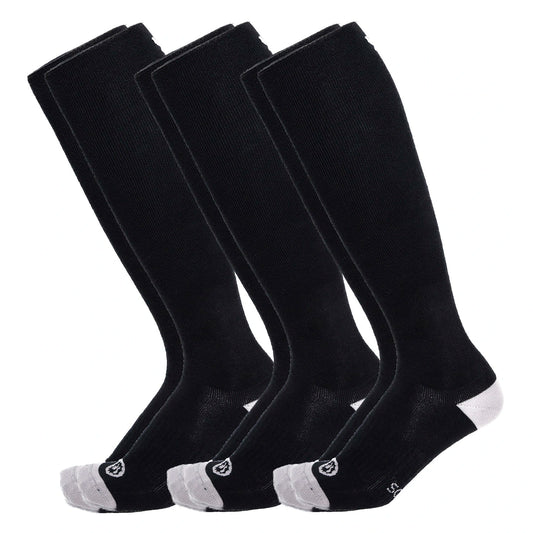
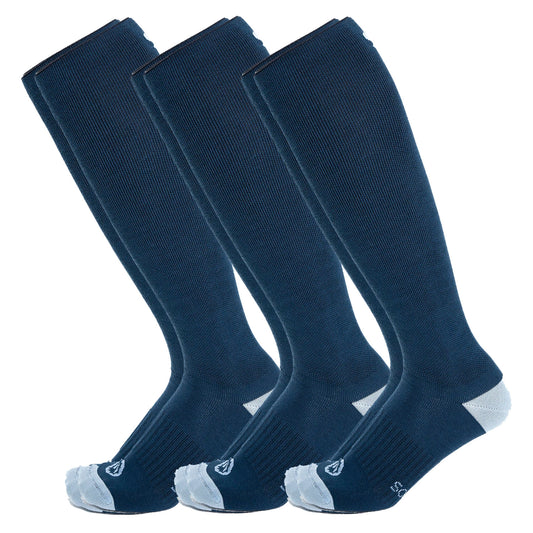
And if you are going to need several pairs to always have a dry one in your backpack, here they are together:
May the only thing that slows you down on your next route be stopping to look at the scenery. Remember that not all compression socks are Calcetinos… nor are they the same 😉
Sources
- Rushton R, Richie D. Friction blisters of the feet: a new paradigm to explain causation. Journal of Athletic Training, 2024; 59(1): 1-7. Included in A New Paradigm for Friction Blisters on the Feet, Podiatry Today, July 2024.
- General Council of Official Podiatrist Colleges. The Camino de Santiago and blisters.
- Worthing RM, Percy RL, Joslin JD. Prevention of Friction Blisters in Outdoor Pursuits: A Systematic Review. Wilderness & Environmental Medicine, 2017.
- Adhikari S, Dawadi S, Upadhyay B. Friction Blister by Climbing Harness. Wilderness & Environmental Medicine, 2019.
- Preevid, Evidence-Based Question Bank of the Murcian Health Service. Should skin blisters be emptied or left intact?, 2025.
- Hill J, Howatson G, van Someren K, Leeder J, Pedlar C. Compression garments and recovery from exercise-induced muscle damage: a meta-analysis. British Journal of Sports Medicine, 2014; 48(18).
- University of Navarra Clinic. Intermittent claudication, Medical Dictionary.
- Spanish Association of Nursing in Cardiology. Peripheral arterial disease.