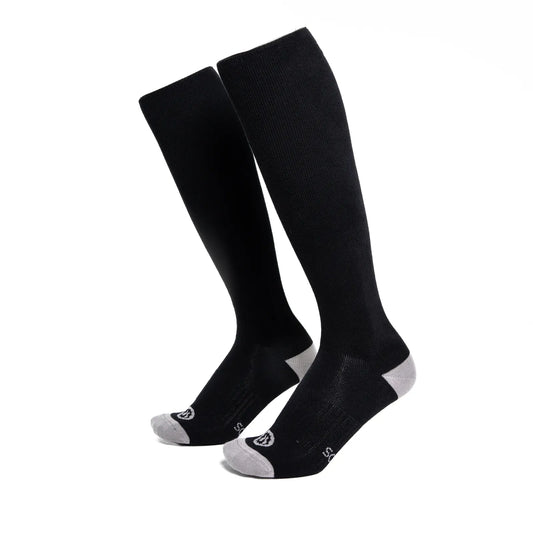
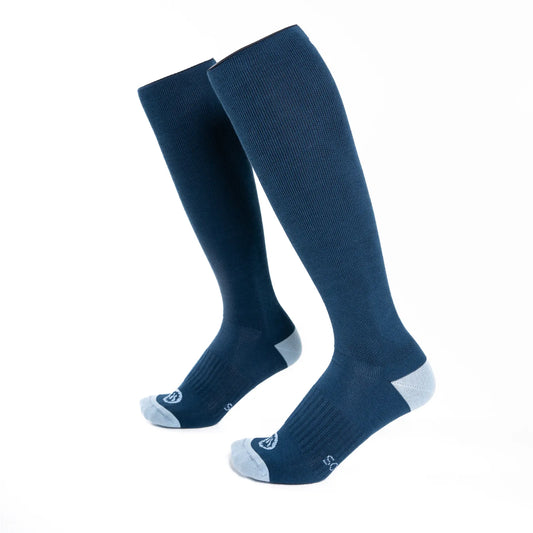
Your backpack is packed, but you're missing the little things. For the Camino de Santiago, technical fiber socks without toe seams are a good choice—one pair per stage, with a spare change for midway through the day if you feel your feet getting damp.
The main point has been made. Now for the why, which is what will help you when you're at the store making your decision. Much of what will keep you from limping into Santiago is hidden inside your boot: in those six consecutive hours of friction.
Why do blisters occur on the Camino de Santiago?
A study conducted in two hostels in the province of León, involving 315 pilgrims of 47 nationalities, found that 74% ended up with at least one blister after several stages1. This has nothing to do with personal endurance; there are 3 reasons that explain it, and we will walk you through them:
The first is friction. Your foot moves a few millimeters inside the boot with every step, and in an average stage of 23 kilometers, that accounts for tens of thousands of small rubbings in the same spot2.
The second is moisture, which multiplies everything mentioned above. Think about when you wash a dish with a soaked rag: it grabs and drags. The same dry rag slides easily. Your damp skin inside the sock does exactly that: it grabs onto the fabric instead of letting it glide.
And the third is the seam, which concentrates all the pressure that should be distributed across the foot into a two-millimeter line.
How much does wearing wet socks influence this?
Much more than it seems. In that same study, having wet socks at the end of the stage appeared as a direct risk factor for injury. Furthermore, 47.9% of pilgrims walked with damp socks, but only 20.3% changed them for a dry pair2.
Almost half were walking with wet feet, and only one in five did something about it. That is why breathability matters even more than the thickness of the sock. That, and the spare pair you carry in your backpack, of course!

What material should socks for the Camino be made of?
Nowadays, those who are well-informed look for their socks based directly on the material, and for good reason, because the material is what determines what happens with sweat. Here is what each one does:
- Coolmax and technical polyester. They are designed to pull moisture away from the skin to the outside of the fabric and dry quickly. This is the fabric of our Fresh models, for days of high heat and humidity.
- Polyamide. It absorbs very little water, so it releases moisture quickly and doesn't get heavy against the skin. This is the fiber in the Dynamic, the model we created with walking in mind.
- Bamboo. Very soft and more breathable than cotton, as well as hypoallergenic, so it is your best choice if you have sensitive or atopic skin.
- Merino wool. It regulates temperature very well and retains less odor; it is a material that is as technical as it is specialized. We don't use compression in merino because our socks are designed for daily use, and because for walking many hours, it matters more to us that the foot stays dry and the sole is reinforced. That is where the Dynamic came from.
- Cotton. This is probably the option that suits you best or that you'll want as a rest sock: once you stop for the day, at the hostel, during dinner...
Are cotton socks suitable for the Camino de Santiago?
It depends on who you ask, and this is funny, because the two most official references for the Camino do not say the same thing.
The official blog caminodesantiago.gal recommends "seamless socks made of fibers so that feet breathe well, and never cotton," because "they get wet easily and can cause blisters"4. The equipment list from the Spanish Federation of Associations of Friends of the Camino, on the other hand, asks for "3 or 4 pairs of socks, 100% cotton, if possible seamless"5.
Both recommendations come from people who know the Camino inside out, and both have their logic. Cotton is comfortable, cheap, and breathes well as long as it is dry. The problem appears when it gets wet: it absorbs a lot of water, takes a while to release it, and stays heavy against the skin during the hours when you need it least. And you have already seen what happens with damp feet.
We make our Basic socks in combed cotton and we aren't going to pretend otherwise: they are for daily use. For the stages, with heat and six hours of marching, there are fibers that handle sweat better.
Why do seams and the sole matter so much?
Because they are the two places where the sock stops being a smooth layer and becomes an obstacle. A thick seam at the toes, a decorative relief, an embroidered brand logo on the sole: each of them is a point that applies more pressure than the area around it. And the tighter it is, the more it rubs.
This is the reason why our socks do not have patterns or raised seams. Prints squeeze at specific points and ruin the graduated compression, so we prefer a boring, well-made sock.
The sole is the other half of the matter. A sock for walking many hours needs reinforcement across the entire sole, not just decorative padding on the heel. That is where the Dynamic has a real and verifiable argument: polyamide with a reinforced sole from toe to heel, designed specifically for the wear and tear of walking.

🥿 Dynamic: reinforced sole for long stages
Polyamide with a reinforced sole across the entire base and light graduated compression of 14-17 mmHg verified in an external laboratory. They dry quickly, which is exactly what you need from a sock after six hours of walking.
- Reinforced sole from toe to heel, for the wear of walking
- Quick-dry polyamide, without decorative reliefs or seams
- Made in Spain and OEKO-TEX Standard 100 certified
Compression tested in an external laboratory, not calculated by guesswork.
If you prefer to hear from someone who has taken them further than Santiago, Joan-Enric crossed the Himalayas with them:
What does light compression provide during a 23-kilometer stage?
It is worth separating two things that are often confused. Blisters are a foot issue. Weight, ankle swelling, and that "lead legs" feeling when you reach the hostel are a leg issue. They are two different problems and are not solved by the same thing.
For the latter, light graduated compression lends a hand. It squeezes a little more at the ankle and loosens toward the knee, like squeezing a toothpaste tube from the bottom and not the middle: blood encounters less resistance returning upwards. After a long stage, this translates to legs that feel less heavy, less ankle swelling, and faster recovery for the next morning, when it's time to do it all over again.
Don't expect miracles or anything resembling a medical treatment. It is 14-17 mmHg of graduated compression, a wellness aid for legs that are going to work for twelve days in a row.
How do you choose the size if the sock is compressive?
In the case of compression stockings, you must measure your leg to find the size; your shoe size doesn't matter. The foot part doesn't compress at all; it is always loose, no matter the size you choose. What matters is the measurement of the calf, and that is what the size guide is for.
Three more things to know before the first stage:
- That your Calcetinos feel a bit loose at the top is intentional. They don't have a tight elastic that restricts circulation or leaves marks on your leg. They shouldn't fall down, but they shouldn't squeeze excessively either. If either is an issue, it's likely a problem with the chosen size.
- A slight mark when you take them off is normal, as with any sock in the world. A deep, strangulation-like mark points again to the size.
- If you feel a tingling in your leg when you put them on, that's a good sign. That is the blood starting to move. The itchiness you should avoid is caused by skin irritated by the material, and that's what the soft fibers and OEKO-TEX certification are for.
If this sounds like what you are looking for, the compression stocking collection is the place to start.
What socks should you wear for the Camino in summer?
The Camino is mostly walked from May to September, and on the plateau in July, your feet are swimming inside your boots from kilometer five. In those conditions, a thick mountain sock is overkill.
In the heat, you will need the same thing as in spring, only more demanding: a fabric that doesn't stay soaked, releases moisture quickly, and a reinforced sole for those hours of marching. That is why we continue to recommend the Dynamic for the stages even in August. Polyamide absorbs little water, dries quickly, and if you wash it upon arriving at the hostel, it will be ready for the next morning.
Our Coolmax Fresh and the rest of the summer collection are designed for daily heat, at home or at work. For walking twenty-something kilometers with a backpack, the deciding factor is the Dynamic's reinforced sole.

How many pairs of socks should you take on the Camino?
The Federation of Friends of the Camino suggests 3 or 4 pairs5, a figure that stands the test of reality well: one worn, one drying from the previous day, and one dry spare in an outer pocket for a mid-stage change. The fourth is a buffer for rainy days.
Carrying more isn't always better, because everything you put in your backpack, you pay for with every step. Both the Xunta4 and the Federation5 recommend not exceeding 10% of your body weight, and the study of León's hostels observed that above 14%, your walking pattern starts to change3; carrying extra weight changes your gait, which is another cause of blisters.
How to wash and dry socks at the hostel?
This part isn't on the equipment lists, and it's what decides if you start tomorrow with a dry pair or a halfway-damp one.
- Wash them upon arrival, not after dinner. You will miss every hour of sunlight you lose when 7:00 AM rolls around.
- By hand, with warm water and little soap. Detergent residue remains in the fiber and is what eventually irritates the skin.
- Do not wring them out. Squeeze them between your hands or inside a towel: twisting them deforms the fabric, and a deformed compression sock won't compress the same way.
- Hang them inside out in a breezy, shaded area rather than in direct sunlight; technical fibers dry quickly anyway, and the August sun is harsh on the elastic.
- If they haven't dried, use safety pins. Hanging from the outside of your backpack, they will finish drying while you walk.

Are socks alone enough to avoid blisters?
Not entirely. Socks are one of the four pillars, and the other three weigh just as much, if not more:
- Footwear, broken in beforehand. In the León study, 38.7% of pilgrims were wearing brand new boots or boots used less than ten times2. Non-broken-in boots will cause blisters in the first few kilometers.
- Footwear size. With your feet swollen in the afternoon, you need a finger's width of space in the front: what feels just right in the morning will be tight by 5:00 PM.
- The weight of the backpack, which we already saw affects your gait.
- And even the terrain. The same study measured less risk walking on dirt than on asphalt2, so when the Camino gives you the option of a path parallel to the road, take it.
The right sock removes one variable and keeps your feet dry for many more hours. The other three are choices you make before leaving home.
And if you want the detail on why a blister forms and what to do once you already have one, we cover it in full in blisters from walking.
This content is informational and does not replace the assessment of a healthcare professional. If a blister becomes infected, if the pain does not subside with rest, or if you have any diagnosed circulatory or skin issues, consult your doctor or a podiatrist before setting out on the Camino.
Frequently asked questions
What should I wear on my feet for the Camino de Santiago?
Broken-in footwear with a finger's width of room in the front, and technical fiber socks without toe seams, with enough height to prevent rubbing against the boot's edge. One pair per stage and one dry spare in an outer pocket to change into midway through the day if you notice dampness.
What socks should I use to avoid blisters?
Those that keep the foot dry and have no reliefs. Fibers that pull moisture away and dry quickly, such as Coolmax or polyamide, without thick toe seams or embroidery on the sole. And with the correct size, because a sock that bunches up rubs just like a seam.
What socks should I use for long hikes?
Those with a reinforced sole across the entire base, which is the area that wears down from walking. If they also have light graduated compression, your legs will feel less heavy at the end of the stage and recover better for the next day's trek.
How many pairs of socks should I take on the Camino?
Three or four. One worn, one drying, one dry spare, and the fourth as a margin for rainy days. Anything more starts to add noticeable weight to your backpack, which should not exceed 10% of your body weight.
Are cotton socks suitable for the Camino?
For walking stages in the heat, there are fibers that perform better: cotton absorbs a lot of moisture and is slow to release it, and damp feet are the main risk factor for blisters. For the afternoon at the hostel, when your feet are finally resting, it is one of the most comfortable options available.
Should I wear two pairs of socks at once?
It is a classic resource: a thin inner sock that rubs against an outer one, so that the friction occurs between the two fabrics and not against the skin. It works very well for some people. It has two downsides: it generates more heat, and it takes up more room inside the boot, so you must test it at home before the Camino rather than trying it for the first time on the first stage.
And one last thing before you zip up your backpack
Test your socks by walking before you leave. An afternoon of fifteen or twenty kilometers in your area will make it clear if they fit you well and give you room to change your mind without it costing you a toe.
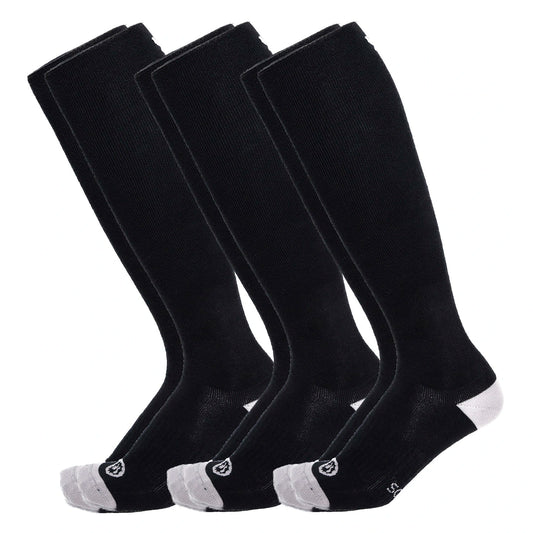
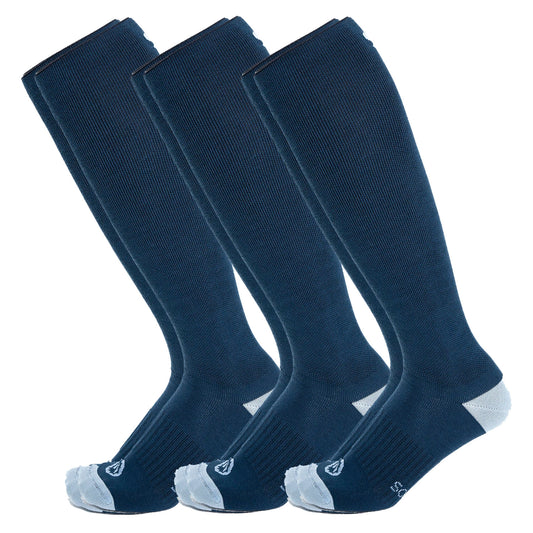
If you want to get the complete set of three or four pairs without making multiple orders, take a look at our packs:
Buen Camino, and may the only thing that hurts when you reach the Plaza del Obradoiro is your face from smiling so much. Remember that not all compression socks are Calcetinos… nor are they all created equal 😉
Sources
- The Camino de Santiago and blisters. General Council of Official Podiatrist Associations
- 74% of pilgrims who walk the Camino de Santiago get blisters after several stages. Professional College of Podiatrists of Aragon
- Factors influencing the appearance of foot dermatological lesions during hiking identified. Fundación Descubre, on the Miguel Hernández University study published in the Journal of Tissue Viability
- Essentials to take on the Camino de Santiago. Official blog of caminodesantiago.gal
- Equipment for the pilgrim on foot. Spanish Federation of Associations of Friends of the Camino de Santiago