Economy class syndrome, or traveller's thrombosis, is when a blood clot forms in the veins of the legs after spending many hours sitting still on a long journey.
Twelve hours of flying ahead. You fasten your seatbelt, dinner arrives, you watch two films and doze off with your head resting wherever you can. When you land, your shoes are a little harder to get on than when you left and your legs are asking for a walk. For almost everyone, that's where the story ends.
In some people, however, those hours of stillness can end in a clot. It's not the usual outcome, and even so it's worth knowing who is more at risk, which signs to watch for and which habits help on long flights. Let's go through it calmly.
What is economy class syndrome?
It's the popular name for deep vein thrombosis linked to travel: a blood clot that forms in the deep veins of the legs because of lack of movement and the cramped seat during a long journey by plane, train, bus or car1.
To understand why it happens, think of a stream and a pond. Running water stays fresh; still water... stagnates. The blood in your legs makes its way back to the heart mainly thanks to your calves: every time you take a step, the calf muscle contracts, squeezes the veins and pushes the blood upwards. Sitting still for hours, that pump stops, the blood flows more slowly, and that makes it easier for a clot to form2. If you're curious about how that return journey works, we explain it in the post on how to improve blood circulation in your legs.
The reason doctors keep an eye on it is that the clot can break loose and travel to the lungs, which is known as a pulmonary embolism2. It's uncommon, and that's exactly why it's worth knowing the signs first.
Did you know the name was coined in 1977?3 It caught on when, with the boom in air travel at the end of the 20th century, cases of thrombosis on long economy class flights were seen to rise. Over time it has become clear that it can happen to any passenger1, wherever they're sitting.
After how many hours of travel is there a risk of thrombosis?
The Spanish Society of Thrombosis and Haemostasis (SETH) explains that the risk rises noticeably on journeys of more than 4 hours, and especially on those longer than 82. Hospital Clínic Barcelona puts the threshold at journeys of more than 4 hours by plane or 6 by car1.
Two things are worth keeping in mind. First, for a healthy person the risk of thrombosis on a plane is very low4: the length of the journey adds up, but most people who develop travel-related thrombosis also have some other risk factor3. Second, it doesn't always show up during the journey: it can appear on landing, or days or even weeks later2.
Who is most at risk of thrombosis on a long flight?
It can happen to anyone who spends hours sitting without moving their legs, healthy people included1. Even so, some circumstances raise the odds. These are the ones listed by SETH and Hospital Clínic1,2:
- Having had a thrombosis before, or a genetic tendency for the blood to clot more easily.
- Older age.
- Recent surgery.
- Pregnancy.
- Taking the contraceptive pill or other hormone treatments3.
- Obesity.
- Cancer and some heart, respiratory or neurological conditions...
If any of these apply to you and you have a long trip ahead, talk to your doctor before you go. They know your case and can decide whether you need anything beyond the general advice1,2. And if you've already had a thrombosis, that conversation comes before booking the flight.
How to avoid thrombosis on long flights?
Almost everything that works has the same goal: stopping the calf pump from sitting idle for hours. The advice is simple, and it's recommended by both SETH and Hospital Clínic1,2.
How often should you get up on a plane?
The recommendation is to get up and walk at least every two hours2. A stroll down the aisle to the back of the plane and back, or standing for a while near the toilets, is enough to get your calves working.
A few things make it easier:
- An aisle seat. If you can choose, the aisle or the emergency exit row gives you more room and saves you asking to get past every time1.
- Keep the space for your feet clear. Put your bag in the overhead locker so you can stretch and move your legs under the seat in front1.
- Stopovers on your feet. Instead of looking for another chair at the gate, take the chance to walk around the terminal1.
- If you sleep, legs stretched out. Better that than curling up with your knees bent against the seat in front3.
And if you're travelling by car, the same idea under another name: frequent stops to get out, walk a little and stretch your legs2.

What exercises can you do in your plane seat?
Between walks, you can move your legs without getting up. SETH advises moving and stretching your legs, rotating your ankles and lifting your knees2. For example:
- Toes and heels. With your feet on the floor, lift your heels keeping your toes down, then the other way round: lift your toes keeping your heels on the floor. This is the one that works the calf most.
- Ankle circles. With your foot slightly raised, draw circles in one direction and then the other.
- Knee to chest. Lift one knee, hold it with your hands for a couple of seconds and lower it. Then the other one.
- Wiggle your toes, which counts too, even inside your shoes1.
A few minutes every hour is enough to avoid spending so long in the same position3. And in the meantime, it's better not to keep your legs crossed for long or leave them dangling1,2.
What should you drink and wear on a long flight?
- Water, often. The cabin air is very dry, and dehydration is one of the factors that add up2,3. Take an empty bottle through security and fill it afterwards.
- Alcohol and coffee, in moderation. They dehydrate you, which is exactly the opposite of what you want1,2.
- Loose clothes and shoes that don't pinch. Your tightest jeans and a belt that digs into your waist can wait for another day. And if you feel like taking your shoes off during the flight, go ahead1.
Do compression socks help on a plane?
There are two different cases here, and it's worth separating them.
If you have risk factors, compression is your doctor's decision. SETH recommends that people at high risk of thrombosis consider graduated compression stockings2, and Hospital Clínic advises checking with your doctor1. Your doctor will tell you what compression you need and whether any other measure is required, and that prescribed compression is bought at the pharmacy.
If you travel with no particular risk, light compression socks are one more comfort habit, like getting up or drinking water. A graduated compression sock squeezes a little more at the ankle and eases off towards the knee, giving your calf a hand during the hours it isn't moving. Mayo Clinic explains that wearing compression stockings on a long flight can reduce swelling in the feet and legs4, which is what you notice most when you land.
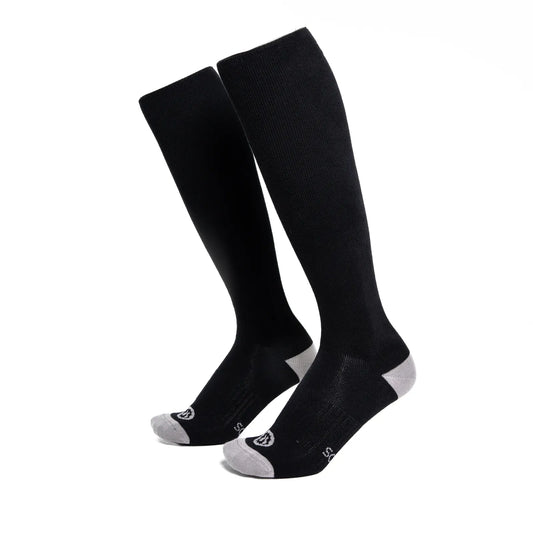
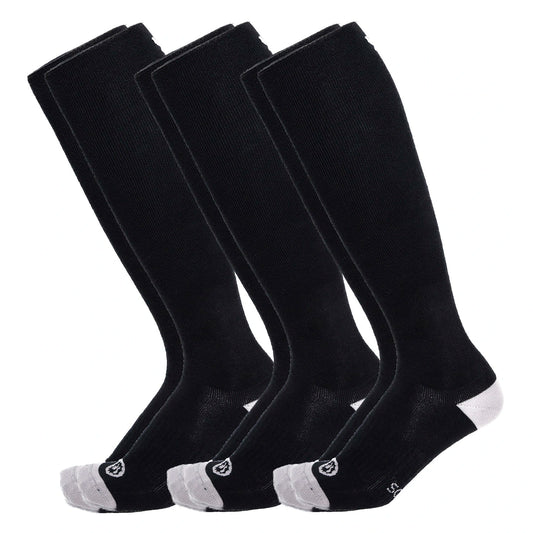
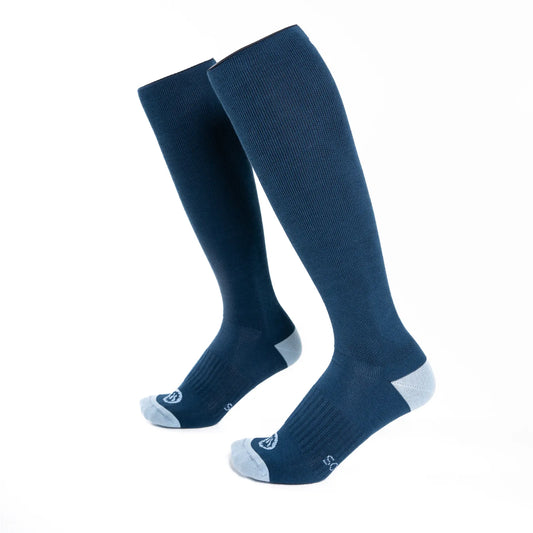
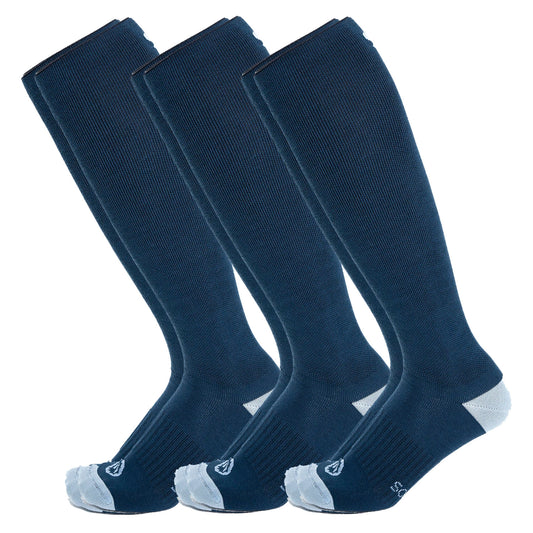
That's what Calcetinos are: light graduated compression socks, with 14 to 17 mmHg tested in an external laboratory, OEKO-TEX Standard 100 certified and made in Spain, to travel more comfortably. They are not a medical device and they don't replace the compression a doctor prescribes.
The practical thing is to put them on at home, before leaving for the airport, and take them off when you arrive. If you're wondering how long to wear them, see how long you should wear compression socks, and for the rest of our travel tips, the page on compression socks for travelling. One more thing: the size is chosen by your calf measurement, which is where the sock spreads the pressure, not by your shoe size. Grab a tape measure and check the size chart before ordering.
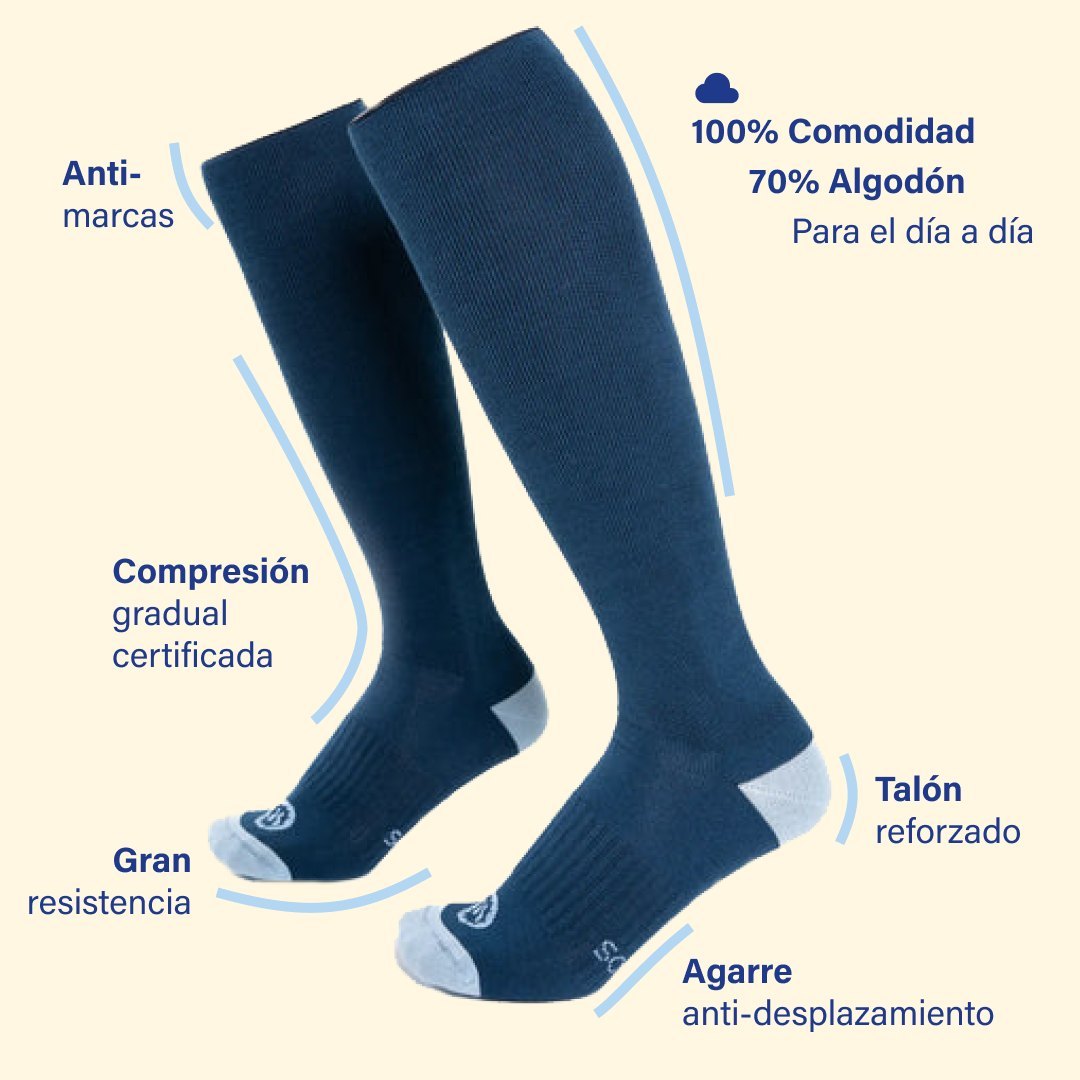
🧦 Basic: light compression for long flights
Combed cotton and light graduated compression of 14 to 17 mmHg verified in an external laboratory. Put them on at home with the rest of your clothes and they'll keep you company from the security check to the baggage carousel.
- Firmer at the ankle, easing off towards the knee
- No tight elastic at the top and no raised seams
- OEKO-TEX Standard 100 certified and made in Spain
Light graduated compression to travel more comfortably. Not a medical device.
Which thrombosis symptoms should you watch for after a flight?
They most often appear during the flight or right after it, although they can also take a few weeks1. In the leg, these are the signs1:
- Swelling in the calf or thigh, usually in one leg only.
- Pain in that leg, sometimes with difficulty walking.
- Red or bluish skin, and veins that stand out more than usual.
- A tingling sensation.
If you notice anything like this after a long journey, see a doctor as soon as possible and tell them you've been flying.
And if you get chest pain, difficulty breathing, a racing heart, dizziness or fainting, call 112 or your local emergency number, or go to A&E straight away: these can be signs of a pulmonary embolism and need immediate care1.
Swollen feet after flying: is it thrombosis?
Most likely not. Swollen feet and ankles on a long flight are very common and generally harmless: so many hours sitting cause blood to pool in the leg veins, and some of the fluid moves into the surrounding tissue4. That's why your shoes feel tight when you land.
The clue is in how it behaves. Travel swelling usually shows in both feet and goes down as soon as you start moving again. What does call for a check-up is swelling in one leg that doesn't go away, or swelling that starts within two weeks of a long flight4. If what worries you is the swelling itself, why it happens and what to do before, during and after the flight, we break it down in the post on swollen feet on a plane.
Frequently asked questions about economy class syndrome
Does economy class syndrome only happen on planes?
It's more common on flights, and it can also happen on a bus, in a car or on a train, whenever you spend many hours sitting without moving1,2. That's why the advice in this post works just as well for the overnight coach or the drive to the beach.
Does it happen in business class too?
It does. The name comes from economy class, and yet there's no evidence that thrombosis is more likely in economy than in business or first3. More space makes it easier to move, which is what counts, but you have to make the most of it.
Do compression socks prevent thrombosis?
SETH recommends considering them for people at high risk of thrombosis2, and in that case the compression, like any other measure, is prescribed by a doctor. Calcetinos are light compression socks to travel more comfortably: they aren't designed to prevent thrombosis and they aren't a medical device.
If I've had a thrombosis before, can I fly?
That's for your doctor to assess, and it's best to ask before booking your trip1.
Disclaimer: informational content, does not replace the assessment of a healthcare professional.
What to take on your next long flight?
Not much: an aisle seat if you can choose one, a bottle of water, comfortable clothes, and the habit of getting up every two hours even when the film is at its best bit. If you have any risk factor, the appointment with your doctor comes before the suitcase. And if not, light compression socks put on at home make the journey easier: you'll find them all together in compression socks.
Have a good trip, and remember that not all compression socks are Calcetinos... or alike 😉
Sources
- Hospital Clínic Barcelona. Qué es y cómo evitar la Trombosis del Viajero [in Spanish]. 1 September 2022. Available at: clinicbarcelona.org
- Sociedad Española de Trombosis y Hemostasia. La SETH alerta sobre el riesgo de trombosis en viajes de más de 4 horas [in Spanish]. Press release, 24 July 2024. Available at: seth.es
- Ruiz-Giménez Arrieta N, Suárez Fernández C. Tromboembolismo venoso y síndrome de la clase turista: medidas preventivas [in Spanish]. Información Terapéutica del Sistema Nacional de Salud. 2007;31(4):118-126. Spanish Ministry of Health. Available at: sanidad.gob.es
- Mayo Clinic. Foot swelling during air travel: A concern? Available at: mayoclinic.org