Feet swell on a plane because you spend hours sitting without moving your calves, and blood and fluid end up pooling in your ankles and feet.
Ten hours of flight. You've taken your shoes off after dinner, watched two movies, and dozed off with your head wherever you could. They announce the landing, you go to put your shoes on... and the shoe that slipped on without a thought this morning is now impossible to get on. Your ankles look like someone else's, and your legs feel like lead.
It happens to a lot of people, and there is an explanation. We are going to look at why feet and legs swell on a long flight, what you can do before leaving and during the trip, and how to reduce the swelling once you've landed.
Why do feet swell on an airplane?
Think of a piping bag. For the cream to come out the top, your hands squeeze from the bottom, again and again. If you leave the bag on the counter, the cream stays still at the bottom.
Your calf acts as those hands. Each time you take a step, the calf muscle contracts, squeezes the veins running through it, and pushes the blood upward, back to the heart. In an airplane seat, those hands stay still. Blood tends to pool at the bottom, in the veins of the legs, and the posture itself, with knees bent, increases the pressure within them. Part of the fluid ends up leaving the blood and entering the surrounding tissues1, which is what you see as swelling.
That is why it is noticed most in the feet and ankles: they are the lowest point, and fluid always seeks to go down. In the legs, it is felt more as a sensation than a shape: heaviness, tightness, the urge to stretch them. It is the same mechanism as in the office, which we discuss in our post on swollen legs from sitting, only on a plane, it is combined with a narrow seat and little desire to wake up the person next to you to go out to the aisle.
There are a couple of other factors that add to this: salty snacks, because salt encourages the body to retain fluid, and tight clothing or shoes2.
Is it normal for feet to swell when flying?
Yes. Swelling of the feet and legs during air travel is common and, generally, harmless1. It is usually noticed in both feet and, in general, it goes away on its own2 as you start moving again.
What does not fit this picture, such as a single swollen leg or swelling that does not go down, warrants a look by a doctor. We will see more on that below.
How to prevent feet from swelling on the plane?
Everything that works aims for the same thing: to keep the hands of the piping bag from spending the entire flight with arms crossed.
What to wear before flying?
- Loose-fitting clothing. Save the tightest jeans and the belt that digs into your waist for your destination3.
- Footwear with room. Better to choose comfortable, slightly roomy shoes that don't squeeze rather than ones that fit tightly2,3. If you are going to take your shoes off during the flight, keep in mind that you will have to get your foot back into them when landing.
- Socks that don't squeeze where they shouldn't. Regular socks with strong elastic at the ankle or calf leave marks and act as a plug2. Gradual compression socks work the other way around, and we will tell you why shortly.
- Aisle seat, if you can choose. It saves you from asking to pass every time you want to get up3.
- Backpack up top. Leave the footwell clear so you can move and stretch your feet under the seat in front of you3.
What to do during the flight to keep your legs from swelling?
Get up and walk the aisle every two or three hours3. To the back of the plane and back, or stand for a while near the restrooms: that is enough to get the calf muscle working.
Drink water often, and have alcohol and coffee in moderation3.
Avoid crossing your legs for long periods, or leaving them hanging without support3. And if you sleep, it is better to do so with your legs stretched out rather than curled up against the seat in front.
During layovers, take the opportunity to walk through the terminal instead of looking for another chair at the boarding gate3.
What leg exercises can you do in your airplane seat?
Between walks, moving your feet and toes in your seat already helps3. Four movements you can do without anyone noticing:
- Heel raises. With your toes on the floor, lift both heels, hold for a second, and lower them. This is the one that works the calf the most.
- Toe raises. The reverse: heels on the floor and lift your toes.
- Ankle circles. With one foot slightly lifted, draw circles in one direction and then the other. Then do the other foot.
- Toes too. Curl and stretch them inside your sock; it counts even if it's not visible.
A few minutes every hour, while the movie is starting or you are waiting for the dinner cart, and you're all set.

Do compression socks help prevent feet from swelling on a plane?
Here lies the problem with all the advice above: they depend on you. And on a ten-hour flight, you are going to fall asleep, you are going to get hooked on a series, and the aisle will be blocked by the cart just when you felt like getting up.
A compression sock works in the meantime. Gradual compression squeezes a little more at the ankle and loosens toward the knee, as if someone were still holding the piping bag from below while your calves rest. Mayo Clinic explains that wearing compression stockings on a long flight can reduce foot and leg swelling1.
And here it is useful to distinguish feet from legs. Compression works on the leg, from the ankle to the calf. The foot remains loose, without being squeezed, regardless of the size you choose. That is why the size is determined by measuring the ankle and the calf, not by looking at your shoe size: in the size guide, you have how to do it in five minutes.
The practical thing is to put them on at home, before leaving for the airport, while your legs are still not swollen, and take them off upon arrival. They are worn throughout the flight, even if you fall asleep in your seat. If you find them hard to put on, here is how to put on compression socks without a struggle, and if you have questions about how many consecutive hours, you can find that in how long to wear compression socks.

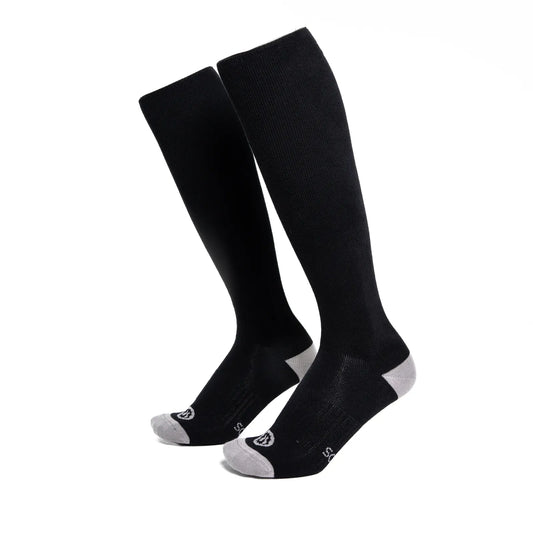
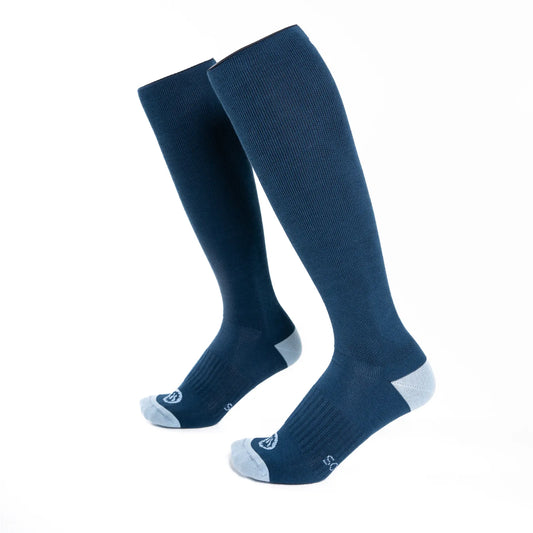
Calcetinos are light, gradual compression socks, with 14 to 17 mmHg tested in an external laboratory, OEKO-TEX Standard 100 certification, and made in Spain. If you want to know what that figure means, we explain it in what mmHg means in compression stockings. They don't have tight elastic at the top, on purpose, so that after hours of sitting they don't leave marks on your leg. They are not a medical device. If your doctor has prescribed specific compression for the trip, that is what you should use, and it should be purchased at a pharmacy.
When to put them on, how many consecutive hours, and the rest of the travel details can be found on the page for compression socks for air travel.
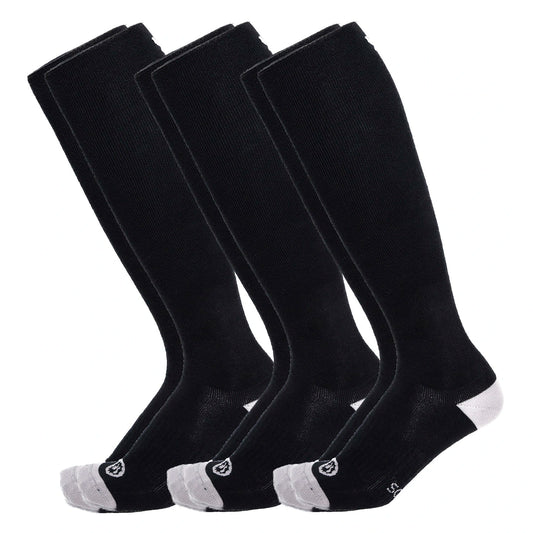
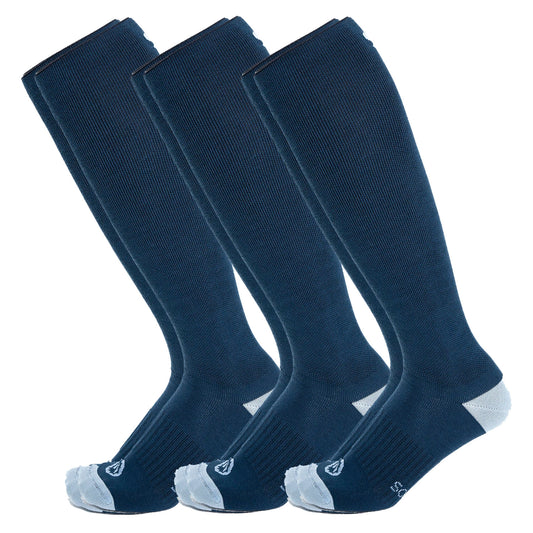
All models have the same light gradual compression and the same length, right to just below the knee. What changes is the material, and that is decided by your trip.
Calcetinos for your next flight
All with light gradual compression and reaching just below the knee. Choose the material based on the trip.


Light gradual compression of 14 to 17 mmHg, made in Spain. Not a medical device.
What about long car or bus trips?
Exactly the same thing happens. It makes no difference to your leg whether it is on a plane, a night bus, or in a car on the way to the beach: it has been bent and stationary for hours, and it reacts the same way.
In a car, you have one advantage that the plane doesn't give you: you can stop. Take advantage of the stops to get out, walk around the rest area, and do the heel raises a couple of times while standing. On the bus, the airplane seat advice applies just the same: ankles, toes, and heels, and compression socks put on at home, which are just as welcome on an eight-hour trip.

Swollen feet after a flight: how to reduce the swelling?
If you have already landed and your ankles still look like boots, to reduce foot and leg swelling after an airplane trip, the best thing to do is the opposite of what you did in the seat:
- Walk. From the plane to the baggage claim, and from the claim to the exit, without looking for the moving walkway. Walking gently gets the calf working again2.
- Legs up. As soon as you arrive at your hotel or home, spend some time lying down with your legs on a couple of cushions, or with your feet resting against the wall2.
- Comfortable shoes. If you have roomy sneakers in your suitcase, now is their time2.
- Arrival dinner, without overdoing the salt2.
Many times, leg pain after traveling by plane is that same heaviness from so many hours of being still, and it goes away with the same measures. If you want the full picture of causes, beyond travel, we review it in our post on swollen legs.
When is the swelling not just a matter of travel?
Airplane swelling has a recognizable signature: both feet equally, no severe pain, and it decreases as soon as you move. If anything deviates from that, consult a doctor:
- If only one leg swells and the swelling doesn't go down, or if it appears in the two weeks following a long flight1.
- If that leg hurts, is red or warm to the touch, or if the swelling appears suddenly2.
- If after a few days at home, moving around and with your legs elevated, the swelling does not improve or gets worse2.
And if you notice shortness of breath or chest pain, call 112 or go to the emergency room without waiting2.
These are the warning signs to look out for in case there might be a clot. Light compression socks help you travel more comfortably, and they are not intended to prevent thrombosis: if you have any risk factor, a conversation with your doctor comes before packing your suitcase. If you want to know more about traveler's thrombosis, who is at higher risk, and what symptoms to watch for, we cover it in our post on economy class syndrome.
Frequently asked questions about swollen feet on a plane
How long does it take for swelling to go down after flying?
It usually goes down on its own as soon as you return to walking and moving, and putting your legs up for a while helps a lot2. If after a few days it has not improved, or only one leg has swollen, it is time to consult a doctor1,2.
Do feet swell more on long flights?
Yes, because what causes swelling is sitting for a long time without moving1, and the more hours you spend like that, the more fluid accumulates at the bottom. On a one-hour flight, there's hardly time to notice it; on a ten-hour one, your shoe will tell you.
Can I sleep on the plane in compression socks?
Yes. When asleep in your seat, you are still sitting, with your legs below the level of your heart, so the compression still has work to do. It is exactly the time when your calves won't be moving.
Are compression socks useful for car travel?
Yes, for the same reason as on a plane: on a long journey, you are sitting with your legs still. Put them on before leaving and combine them with stops to walk a bit.
Disclaimer: informational content, does not replace the assessment of a healthcare professional.
What are you putting in your suitcase for your next flight?
Not much: shoes with room, the habit of getting up every two or three hours even if the movie is at its best, and compression socks put on at home, which are the only ones that keep working when you fall asleep. You can find them all together in compression socks.
Have a good trip, and remember that not all compression socks are Calcetinos... nor are they all equal 😉
Sources
- Mayo Clinic. Swelling of feet during air travel: should I be concerned? April 14, 2026. Available at: mayoclinic.org
- NHS. Swollen ankles, feet and legs (oedema). Reviewed February 26, 2026. Available at: nhs.uk
- Hospital Clínic Barcelona. What is traveler's thrombosis and how to avoid it. September 1, 2022. Available at: clinicbarcelona.org