You sit on the edge of the bed, pick up the sock, and the struggle begins. You lean forward, you're out of breath, your back protests, and the sock only makes it halfway up your heel. If this scene repeats every morning, it happens to a lot more people than you imagine. And there's a solution: it's called a sock aid, and it's probably the most useful and least known device in your entire closet.
Let's see what it's for, how to know if you need one, how to use it step by step, and what's true about the DIY fixes circulating online.
What exactly is a sock aid?
It's a structure, usually metal or rigid plastic, shaped like a channel or an arch. You stretch the sock over it, open it wide, and then you just have to insert your foot and pull two long handles until the garment slides up your leg on its own.
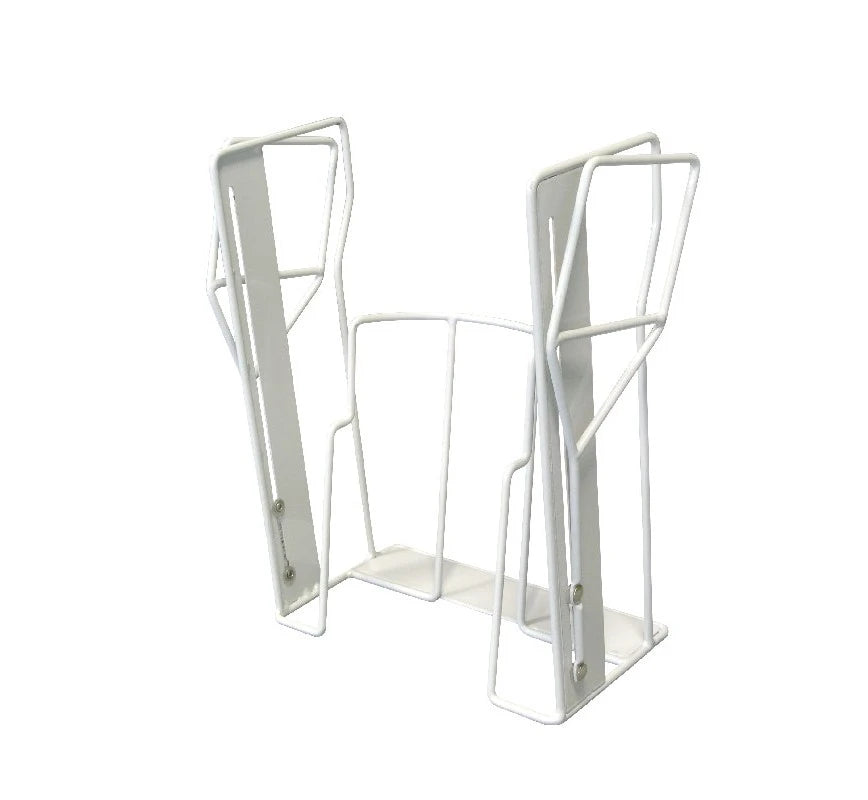
It does with a sock what an embroidery hoop does with fabric: it keeps it open and taut, so you can work with it without having to hold it with both hands at once. You provide the direction, the device provides the shape.
Sock aid or compression stocking aid: are they the same?
Almost. The difference lies in the fabric they have to deal with.
A regular sock is soft and yields without resistance, so any simple aid will do. A compression stocking, on the other hand, is woven to compress, and the more it compresses, the more it resists stretching. That's why aids designed for compression are usually made of metal, with a wider channel and longer handles: they need to withstand tension without bending.
If you're looking for one and only plan to use it with thin cotton socks, almost any will work. If you're going to use it with compression stockings, check that the manufacturer indicates how many mmHg it can handle. As a reference, the Calcetinos aid is compatible with compressions from 14 to 30 mmHg, and even higher.
How to know if you need one?
It's important to be honest with yourself here, because many people buy the device without needing it, and many others have been suffering for years without knowing it exists.
Signs that you might need one
- Bending down to your foot is difficult or painful. Regardless of the reason: overweight, lower back pain, hip or knee arthritis, or simply morning stiffness.
- Your hands don't cooperate. With arthritis in your fingers, weak grip strength, or long nails, gripping and stretching taut fabric is precisely the most uncomfortable action.
- You're pregnant and can no longer comfortably reach your foot. From the second trimester onwards, your belly gets in the way, and bending over becomes quite difficult.
- You live alone and don't want to depend on anyone for something as basic as getting dressed in the morning.
- You wear strong compression stockings prescribed by a professional, which compress much more than daily wellness ones.
- You've recently had hip or knee surgery. In that case, the recommendation usually comes directly from the healthcare team: after a hip replacement, it's recommended to avoid flexing the hip more than 90 degrees and to use dressing aids, including an aid for putting on socks1.

Signs that you probably don't need one
If you have good mobility and wear light compression socks, you most likely don't need any device. With the correct technique, turning the sock inside out to the heel, inserting your foot, and unrolling it upwards, it can be done in less than a minute. If you're interested in the well-explained manual method, you can find it step-by-step in the post on how to put on compression socks correctly.
And if you struggle a lot even with light compression, check the size before buying anything. The size of a compression stocking is chosen by the leg measurement, not the foot measurement: many people only look at their shoe size, end up with a size that's too small, and then struggle every morning with a garment that was never going to fit well. You can check this in the Calcetinos size guide.
How to use a sock aid? Step by step
It seems more complicated than it is. The first time will take a couple of minutes, and by the third time, you'll do it in half a minute without thinking.
- Sit in a stable chair with a backrest, better than on the bed. You need firm support to pull upwards.
- Stretch the sock over the structure, covering it completely, with the heel well centered and the toe at the closed end.
- Leave the handles hanging towards you and place the aid on the floor, in front of your feet.
- Insert your foot into the opening and slide it all the way down until you feel the toe of the sock reach your toes.
- Pull both handles upwards at the same time, slowly and continuously. The sock will move up your foot and leg as the device withdraws on its own.
- When it reaches below the knee, remove the aid and adjust the folds with the palms of your hands, without pinching the fabric with your nails.
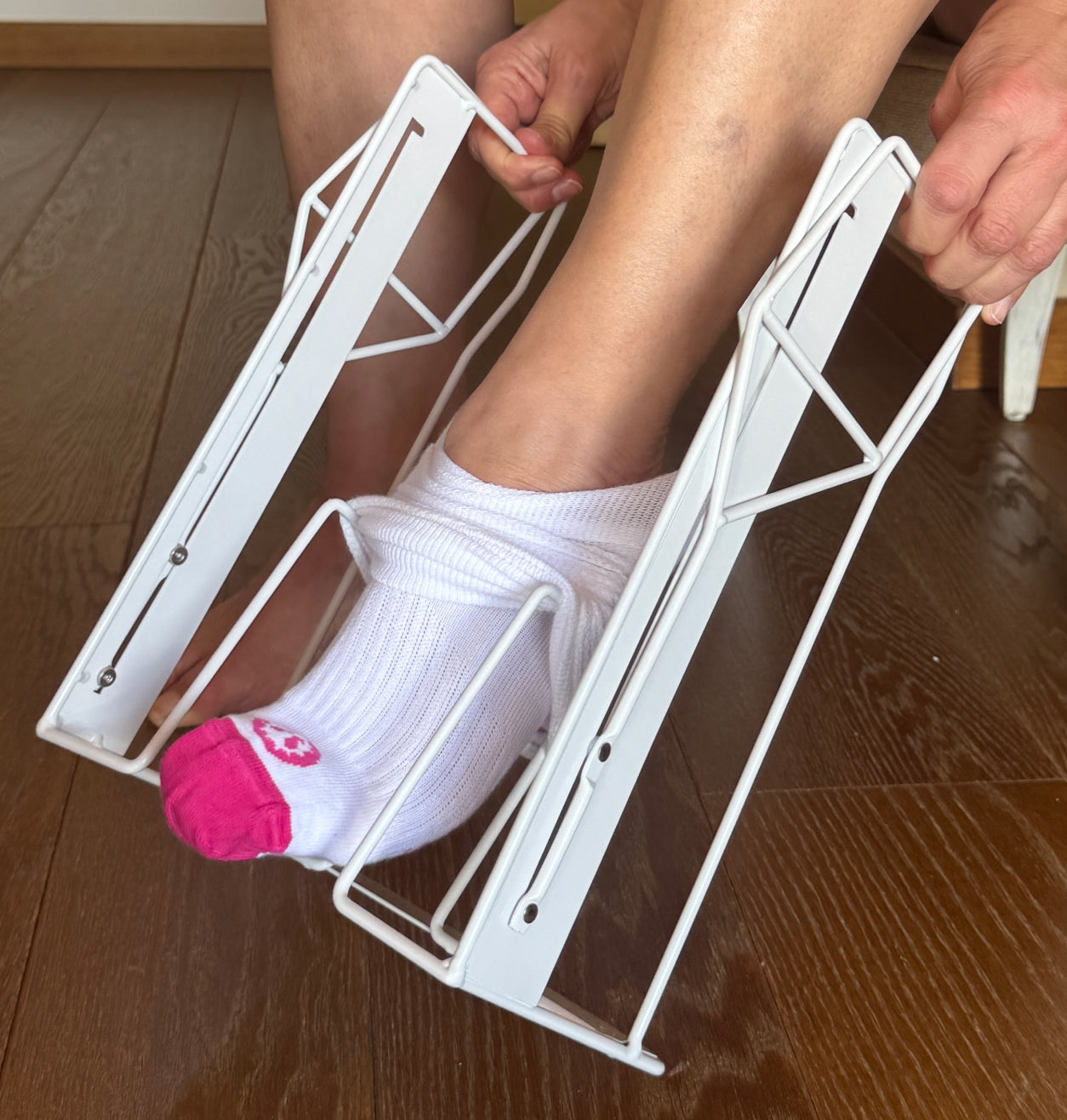
If you prefer it in motion, here it is in less than a minute:
A couple of tips that make a difference: do it first thing in the morning, when your leg is less swollen and everything goes on better; and don't pull in jerks, but with continuous traction, because compressive fabric responds better to consistency than to brute force.
Does a homemade sock aid work?
This is one of the most searched questions, so let's address it directly. There are three common DIY fixes circulating, and not all of them are equally effective.
- The plastic bag. You put your foot inside a thin bag and then put the sock over it: the plastic reduces friction, and the garment slides on much better. Then you pull the bag out through the toe if the stocking is open-toed. It works surprisingly well for sliding, but it doesn't save you from having to bend over, which is precisely the problem for most people.
- The silk sock or stocking underneath. This is the same idea, in an elegant and reusable version. Did you know that this trick has been in hospital protocols for decades? In British hospitals, open-toe stockings are provided with a slippery sleeve precisely for this, so that the foot can enter without the stocking getting stuck on the toes2.
- The improvised aid made from a cut-up bottle or a cardboard tube. This is where things get complicated. The idea is correct, but the material doesn't withstand the tension of a compression stocking, it bends as soon as you pull, and the cut edges can snag the fabric. And a snag in a compression stocking usually means the end of that stocking.
In short: homemade fixes solve friction well but posture poorly. If your problem is that the sock gets stuck, try the bag before spending money. If your problem is that you can't reach your foot, no homemade trick will fix it, and that's when the device is worth it.
What if I don't have an aid and don't want to bother with DIY?
There's a reasonable alternative: ask someone for help for the first week while you get used to it, and in the meantime, practice the heel technique, which involves turning the sock inside out to the heel before inserting your foot. It's not as comfortable as the device, but for light compression and normal mobility, it's more than enough.
The tighter the stocking, the harder it is to put on
The difficulty of putting on a stocking doesn't depend as much on your hands as on how much compression the garment has.
Putting on a strong compression stocking with bare hands is much like trying to fit a duvet into a cover that's just a bit too small: the fabric doesn't give, and you have to exert all the force yourself. And this has a serious consequence, because in a qualitative study published in PLOS ONE with patients who had to wear compression stockings, the difficulty of putting them on emerged as one of the main reasons they ended up leaving them in the drawer3. A garment you don't wear is useless, no matter how good it is.
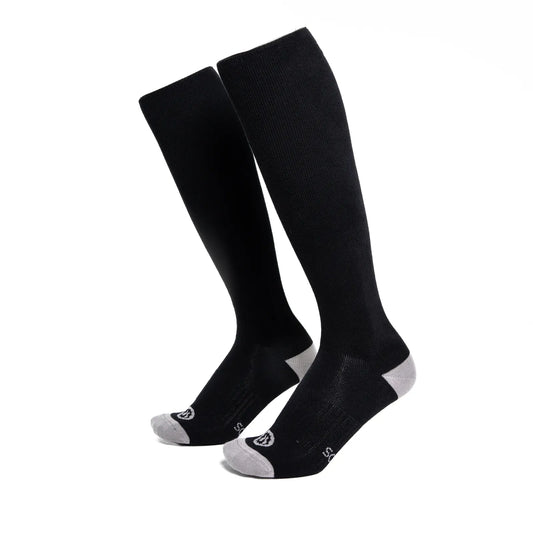
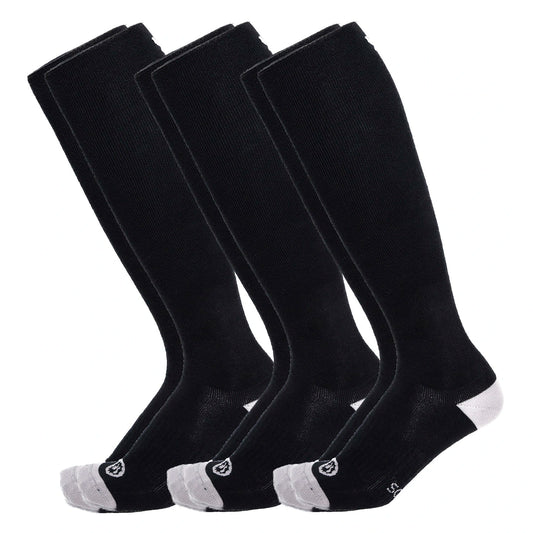
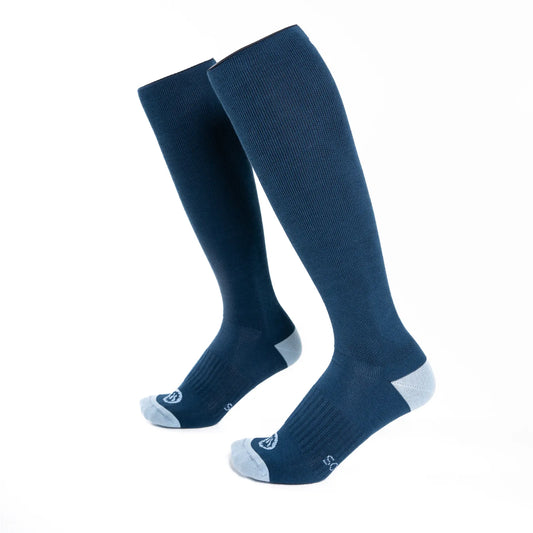
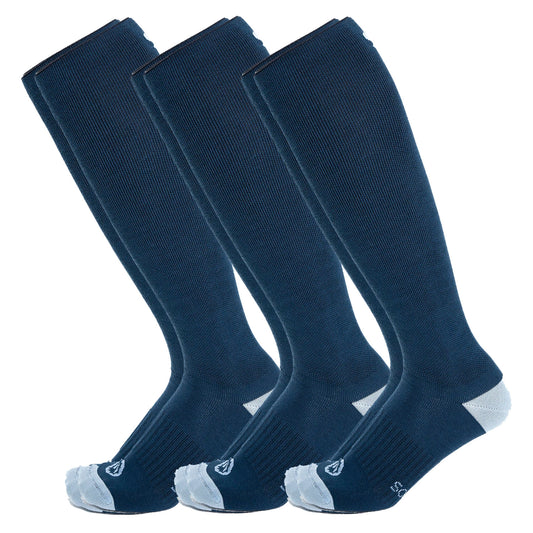
Calcetinos gradual light compression socks are in the light range, from 14 to 17 mmHg tested in an external laboratory, so they require much less effort to put on than a prescribed stocking of 20, 30, or more mmHg. Additionally, they don't have a tight elastic band at the top, which is a deliberate design choice to avoid cutting off circulation or marking the leg, and it also makes them easier to put on. If you notice that the top part is a bit loose, it's by design, not a flaw.
Even so, if you have limited mobility or weak hands, the aid turns a strenuous maneuver into a thirty-second action. And that's the difference between using them daily or abandoning them after a week.
🧦 The Calcetinos aid: get dressed without bending over
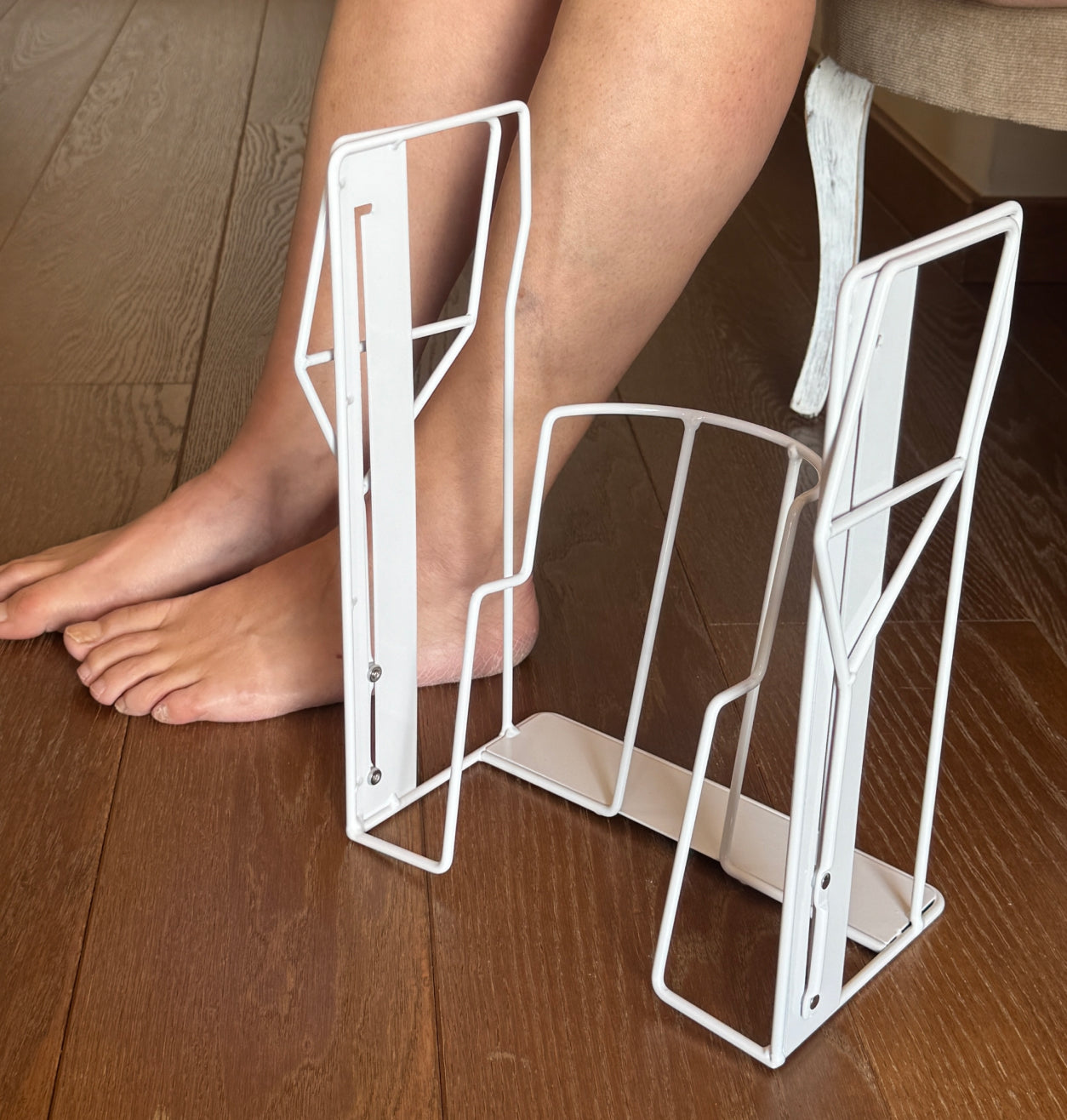
Metal structure with retractable and height-adjustable handles, to put on your socks and stockings without bending your back or straining your hands. It disassembles and stores in any drawer.
- Adjustable height from 31 to 54 cm, to adapt it to your chair
- Compatible with compressions from 14 to 30 mmHg, and even higher
- Long handles to pull without bending down to your foot
If the maneuver is no longer a problem, the socks end up being worn. Which is the point.
What to look for before buying an aid?
Four things to consider, because these determine whether you'll use it every day or if it will end up forgotten:
- The material and rigidity. Metal or rigid plastic if you're going to use it with compression. Soft plastic ones bend when you pull and aren't very useful.
- The height of the handles. If you buy one with short handles and the problem was precisely that you couldn't reach the floor, you haven't solved anything. Look for adjustable ones.
- The compression it supports. This should be indicated in mmHg. If you're going to use it with prescribed high-compression stockings, check this first.
- That it can be stored. A device that only fits upright in a corner ends up getting in the way, and what gets in the way stops being used.
As for the price, the range is very wide, and it's worth looking at what's behind each figure. The cheapest ones are usually made of soft plastic and come from Asian marketplaces, with shipping costs that eat up a good portion of the savings and no one to complain to if the device arrives bent. At the other extreme, there are orthopedic models that cost much more than most people need. The Calcetinos one falls in the middle, made of metal, with adjustable height and customer service behind it, which is where it makes sense for something you'll use every morning.
When to consult a professional
If the difficulty in putting on your socks is new, has appeared suddenly, or is accompanied by pain, tingling, swelling that doesn't go down at night, or changes in skin color on your legs, that's not resolved with a device: make an appointment and get evaluated. The same goes if you wear compression stockings prescribed by a professional and can't put them on, because perhaps what needs to be reviewed is the size or the compression class, and that decision is not yours or ours.
Calcetinos' light gradual compression socks are a daily wellness product for tired, heavy, or swollen legs, without medical use or certification. The aid is exactly what it seems: a help to get dressed more comfortably.
Disclaimer: informational content, does not replace the assessment of a healthcare professional.
What gets worn is what works
The best compression sock in the world does nothing in the drawer. If what separates you from lighter legs at the end of the day is thirty seconds of struggle every morning, you know where to start.
And remember that not all compression socks are Calcetinos… or equal 😉
Sources
- Care of your new hip joint, MedlinePlus (U.S. National Library of Medicine)
- Compression stockings, Guy’s and St Thomas’ NHS Foundation Trust
- Gong J-M, Du J-S, Han D-M, Wang X-Y, Qi S-L. “Reasons for patient non-compliance with compression stockings as a treatment for varicose veins in the lower limbs: A qualitative study”, PLOS ONE, 2020